
Vogzone for X550-T2 10GbE PCIe 3.0 x4 NIC
4.3Editor score
Dual RJ45 ports for redundancy
Intel X550AT2 controller for stability
Firmware updates without BIOS access
Discover the top 10GbE network cards for PC to upgrade your internet speed. We compare features, compatibility, and performance for reliable connectivity.
Upgrading your home or office network requires a reliable 10GbE network card for PC. These adapters enable faster data transfers, smoother streaming, and better gaming performance.
We compared ten top-rated PCIe network cards based on speed, compatibility, and user feedback. Our guide highlights models that deliver consistent performance across various operating systems.
Each pick includes key specs, pros, and cons to help you choose. Prices fluctuate frequently, so check current listings before buying to ensure you get the best deal available.
4.3Editor score

4.2Editor score

4.3Editor score
This side-by-side comparison lists all ten network cards we reviewed. Look at the specs below to find the model that fits your computer and budget best.


The TP-Link TX401 earns our top spot for delivering reliable 10GbE performance with minimal hassle. Its high rating reflects consistent speed and broad OS compatibility.
We may earn a commission when you buy through this link, at no additional cost to you.
Key strengths include the included CAT6A cable, which ensures you can hit full 10Gbps speeds without buying extra accessories. The QoS feature is particularly useful for gamers.
A trade-off is the price, which is higher than some alternatives, but the included cable and support make it worthwhile. It also lacks a second port for redundancy.
Buy this if you want a hassle-free upgrade with top-tier support. It is the best choice for users who prioritize ease of use and gaming performance.
The package comes with a CAT6A Ethernet cable rated for 10Gbps, ensuring immediate performance without extra purchases.
Quality of Service technology helps avoid network congestion, making it ideal for gamers who need low latency.
We may earn a commission when you buy through this link, at no additional cost to you.
The Vogzone X550-T2 is a premium dual-port option built with an Intel controller for serious users. Its features are tailored for servers, workstations, or advanced home labs.
We may earn a commission when you buy through this link, at no additional cost to you.
Dual ports allow for link aggregation or failover, improving reliability. You can also update firmware without rebooting, which is a huge plus for minimizing downtime.
However, you must provide your own Ethernet cables, and it requires a PCIe x4 slot. This limits compatibility with very small form factor PCs.
This model is perfect for users needing redundancy and virtualization support. Choose it if you value enterprise-grade features in a consumer-friendly card.
With two RJ45 ports, you can set up failover or link aggregation to keep your network running even if one cable fails.
The card supports NVM updates directly within the OS, saving time and reducing business downtime for managed servers.
We may earn a commission when you buy through this link, at no additional cost to you.
The VunLink card offers the best balance of price and performance for casual users. It supports full 10Gbps speeds while costing significantly less than enterprise-grade options.
We may earn a commission when you buy through this link, at no additional cost to you.
Its PCIe 4.0 x1 interface allows it to fit in almost any motherboard slot, making it versatile for mini PCs or desktops. Auto-negotiation ensures smooth connection with older routers.
You may need to install drivers manually, and it lacks advanced features like dual ports. These are acceptable trade-offs given its budget-friendly price point.
Ideal for gamers and home labs on a tight budget. If you just need faster speeds without extra features, this is the smartest buy.
The PCIe 4.0 x1 design works in x1, x4, x8, or x16 slots, ensuring compatibility with a wide range of systems.
It automatically switches between 10Gbps, 5Gbps, and 2.5Gbps to match your network infrastructure without manual configuration.
We may earn a commission when you buy through this link, at no additional cost to you.
Intel's X540T2 is a dual-port card known for stability and virtualization features. Its high rating stems from consistent performance and broad network support.
We may earn a commission when you buy through this link, at no additional cost to you.
It supports Lan, iSCSI, and FCoE, making it useful for storage area networks. Virtualization support allows you to split ports into multiple virtual interfaces.
It is an older model compared to newer chips, and prices may be higher due to its reputation. Single-port users might prefer a cheaper alternative.
Buy this if you need dual ports and strong virtualization support. It remains a reliable choice for servers and advanced workstation setups.
Unified networking features allow you to handle LAN, iSCSI, and FCoE traffic through a single, low-cost adapter.
The card supports up to 64 virtual ports, enabling efficient port partitioning for virtualized environments.
We may earn a commission when you buy through this link, at no additional cost to you.
TRENDnet TEG-10GECTX is built for customers requiring NDAA and TAA compliance. It offers solid performance with extra protection and English-speaking support.
We may earn a commission when you buy through this link, at no additional cost to you.
Its 3-year manufacturer protection stands out in this category. You also get clear support channels during business hours, which helps with setup or troubleshooting.
Compliance is limited to US and Canada, and the price is higher than basic models. Users without government needs might find cheaper alternatives.
Choose this if you require compliance for government projects. It is the safest bet for regulated environments needing extra support.
NDAA and TAA compliance ensures this adapter meets federal procurement requirements, making it suitable for government installations.
A three-year manufacturer protection plan provides extra peace of mind compared to the typical two-year coverage on other models.
We may earn a commission when you buy through this link, at no additional cost to you.
The YuanLey card is an affordable Realtek-based option that stands out for its Wake-on-LAN feature. Its rating reflects user satisfaction with speed and reliability.
We may earn a commission when you buy through this link, at no additional cost to you.
Wake-on-LAN lets you remotely power on your PC over the network, useful for home labs or offices. Lifetime support adds long-term value beyond the warranty period.
You need to install drivers, and it lacks dual ports. These are standard trade-offs for cards in this price range.
This is a great pick for remote management users. If you need to wake your system remotely without paying a premium, this card fits the bill.
Wake-on-LAN allows you to remotely start your computer through the network, which is ideal for unattended workstations.
A lifetime support promise ensures you can get help long after purchase, adding confidence to your buying decision.
We may earn a commission when you buy through this link, at no additional cost to you.
While not 10GbE, the TX201 offers 2.5G speeds and the highest rating. It is a cheaper alternative for users who don't need full 10Gbps.
We may earn a commission when you buy through this link, at no additional cost to you.
QoS and Wake-on-LAN are included, making it a strong gaming or home office card. Its low cost makes it accessible for almost any budget.
If your router only supports 2.5G, this card works perfectly. However, true 10GbE users will want faster alternatives.
Buy this if you need a speed boost without breaking the bank. It is the perfect choice for those upgrading from standard Gigabit Ethernet.
The TX201 delivers 2.5 times the speed of Gigabit at a budget price, making it an easy upgrade path.
Its 4.7 rating indicates exceptional user approval, driven by reliable performance and easy setup.
We may earn a commission when you buy through this link, at no additional cost to you.
WAVLINK's card is known for its metal shielding and heat dissipation design. This reduces electromagnetic interference and keeps temperatures low during heavy use.
We may earn a commission when you buy through this link, at no additional cost to you.
It supports x1 through x16 slots, offering flexible installation. Most OSs work well, but you should note the driver signature warning and plastic film removal step.
The metal build adds bulk but improves stability. Those needing a cooler, quieter card will appreciate the heat dissipation features.
Buy this if heat management is a concern. It is ideal for enclosed cases or long-duration file transfers where temperature control matters.
Metal shielding minimizes electromagnetic interference, ensuring a more stable connection for your network adapter.
The design includes features to reduce temperature quickly, maintaining stable network transmission over long periods.
We may earn a commission when you buy through this link, at no additional cost to you.
NICGIGA offers a single-port Intel X540-T1 card at an attractive price. It combines the stability of Intel chips with a budget-friendly package.
We may earn a commission when you buy through this link, at no additional cost to you.
Heat dissipation is emphasized to maintain stability during continuous use. It supports Windows Server and virtualization platforms, making it useful for home servers.
It lacks dual ports and uses an older chipset. However, it remains a solid choice if you want Intel reliability without paying for dual ports.
Buy this for servers on a budget. If you need Intel reliability for virtualization but only one port, this card is a smart pick.
The Intel X540 controller delivers proven reliability, preventing packet loss and ensuring stable server operation.
Support for VMware, ESX, and Linux makes it suitable for virtualized server environments without extra costs.
We may earn a commission when you buy through this link, at no additional cost to you.
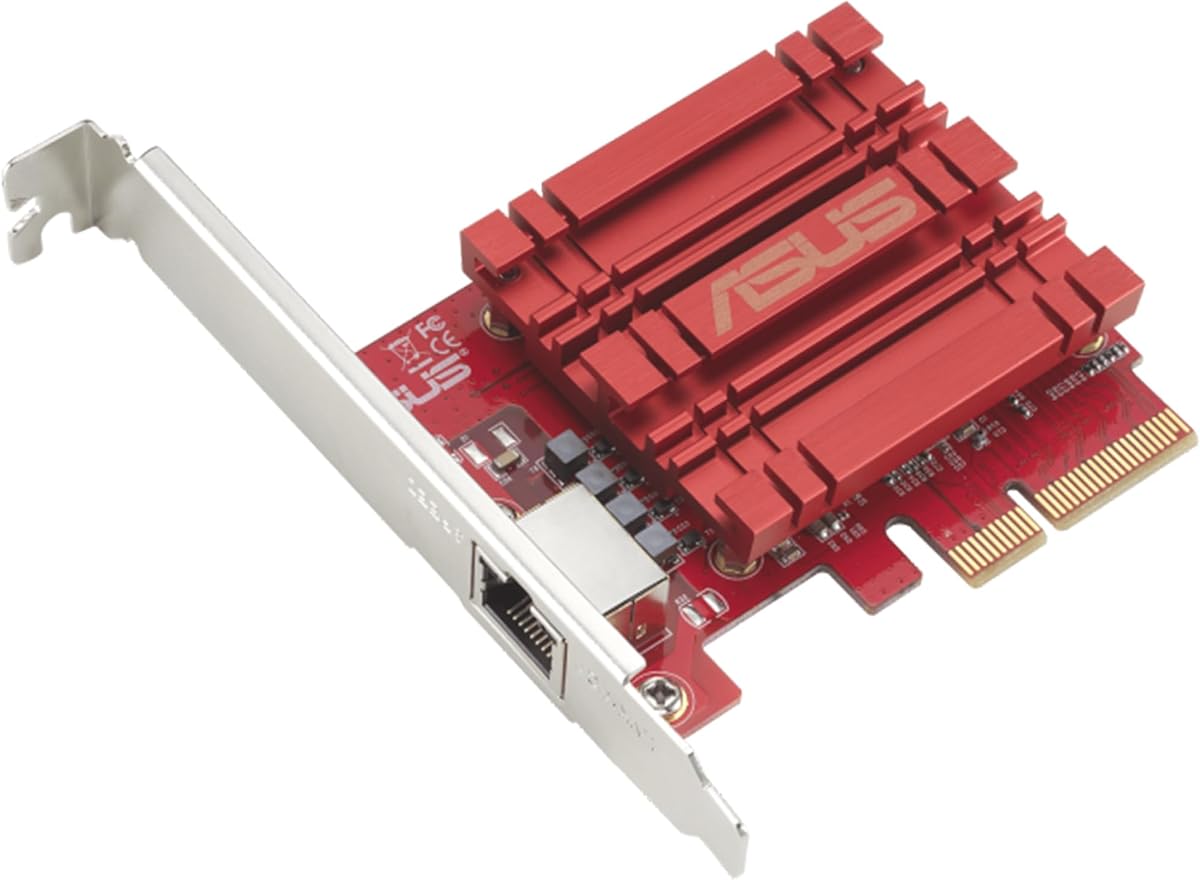
Asus offers a no-frills 10GbE card that focuses on core speed. It delivers reliable performance for users who want a simple upgrade.
We may earn a commission when you buy through this link, at no additional cost to you.
Auto-negotiation ensures compatibility with different network speeds, while QoS helps prioritize traffic. It supports both Windows and Linux easily.
It lacks advanced server features like dual ports or virtualization support. For general home or office use, this simplicity is an advantage.
Buy this if you want a straightforward 10GbE upgrade. It is best for users who don't need complex networking features.
With essential features only, this card is easy to install and use for home or office network upgrades.
The card supports both Windows and Linux, providing flexibility for users who switch between different operating systems.
We may earn a commission when you buy through this link, at no additional cost to you.
Selecting the right 10GbE network card involves evaluating your hardware and performance needs. Below are the factors you should consider.
The chipset determines performance and stability. Realtek offers budget-friendly options, while Intel provides server-grade reliability and virtualization support.
Prioritize Intel for critical servers and Realtek for general use.
Dual ports enable redundancy or link aggregation, useful for servers. Single ports suffice for most desktops and gaming PCs.
Choose dual-port if you need failover or aggregated bandwidth.
Cards use PCIe x1 or x4 slots. Ensure your motherboard has the correct slot and physical space. Some compact cards fit better in mini-PCs.
Match the card's PCIe lane count to your available slot.
Check for native drivers or community support for your OS. Most support Windows 10/11 and modern Linux kernels.
Verify driver availability if you use older Linux distros or servers.
Some cards include CAT6A cables or brackets. This reduces total cost and ensures you have the right cables for 10Gbps.
Look for included cables if you don't already own them.
Support quality varies by brand. Lifetime support may be better than long warranties if the vendor is responsive.
Prioritize brands with responsive technical support channels.
Modern cards like RTL8127AT are energy-efficient. Lower power reduces heat and is ideal for mini-PCs.
Select low-power models for compact builds.
Advanced features like SR-IOV allow multiple virtual machines to access the network directly. These are vital for virtualized labs.
Ensure the card supports your virtualization software.
Turn off your PC and open the case. Locate an available PCIe slot and insert the card firmly. Use the included brackets to secure it to the case.
Connect a CAT6A cable to the card and your router. If your router doesn't support 10Gbps, the card will auto-negotiate to the fastest compatible speed.
Install drivers from the manufacturer's website if needed. After installation, reboot your PC and run a speed test to verify performance.
Yes, you should use CAT6A cables to guarantee 10Gbps speeds over short distances. CAT6 may work for shorter runs, but CAT5e is limited to 2.5Gbps or 5Gbps at best. Many cards include these cables to ensure optimal performance.
Your card will connect to any Ethernet router, but you need a 10GbE router to achieve full speeds. Otherwise, it will auto-negotiate to the router's maximum speed like 1Gbps or 2.5Gbps. Check your router specs before upgrading.
Laptops typically lack internal PCIe slots, so these cards won't fit directly. Some models support Thunderbolt external enclosures, but compatibility varies. Desktop PCs are the intended use for these PCIe adapters.
Most modern cards are plug-and-play on Windows 10/11 and newer Linux kernels. However, some models may require manual driver installation for older systems. Always check the manufacturer's site for the latest drivers.
Dual-port cards are essential if you need redundancy or want to aggregate bandwidth. For single-device users, a single-port card is cheaper and sufficient. Choose dual-port if you run servers or need failover.
QoS prioritizes bandwidth for tasks like gaming or streaming, reducing lag during network congestion. This is especially useful in households where multiple devices share the internet connection simultaneously.
The TP-Link TX401, Vogzone X550-T2, and VunLink RTL8127AT represent the best options for general, premium, and budget users respectively. Each offers distinct advantages tailored to specific needs.
Prioritize features like chipset type, port count, and warranty support when deciding. Ensure your PC has compatible slots and your network infrastructure supports 10Gbps speeds.
Prices and availability change frequently. Verify current listings and stock before purchasing to ensure you get the best deal available at the time.