
GQ GMC-300S Digital Nuclear Radiation Detector
4.6Editor score
Real-time Data Logging
Free PC Software Included
Long-lasting Rechargeable Battery
Dosimeter and Graph Modes
This expert guide compares the top ten dosimeter models for accurate radiation detection, safety monitoring, and reliable data logging in diverse environments.
Finding a reliable dosimeter is crucial for safety professionals, hobbyists, and anyone concerned about radiation exposure. A good device offers accurate readings, intuitive controls, and robust alarm systems to keep you informed and protected in any situation.
We evaluated ten top-rated models based on sensor precision, battery life, display clarity, and ease of use. Each product was selected for its ability to detect beta, gamma, and X-ray radiation effectively while providing valuable data logging features for long-term tracking.
Each pick highlights key strengths, specific use cases, and trade-offs to help you choose the right tool for your needs. Please note that availability and specific model configurations may change over time as manufacturers update their product lines and offerings.
4.6Editor score

4.6Editor score

4.6Editor score
The following table provides a side-by-side comparison of all ten selected dosimeter models, highlighting their core specifications and unique selling points to help you make an informed decision.


The GQ GMC-800 stands out as the top overall choice due to its comprehensive feature set and reliable performance. It earns high marks for accuracy and ease of use, making it suitable for both professionals and enthusiasts.
We may earn a commission when you buy through this link, at no additional cost to you.
Its standout feature is the large color LCD display combined with five different alarm types, ensuring alerts are never missed. The device meets US national standards for accuracy and offers extensive data storage options for long-term analysis.
While it is more expensive than budget options, the investment is justified by its robust build quality and advanced capabilities. The weight is slightly higher than ultralight models, but this reflects the durability and internal components.
This device is ideal for anyone needing dependable radiation monitoring at home, in the lab, or during field work. Its balance of precision, user interface, and data management makes it the best overall pick for most users.
The intuitive menu system allows quick navigation between screens without complex setup procedures for immediate reading.
Built-in memory supports data storage for up to ten years, enabling historical tracking and trend analysis over time.
We may earn a commission when you buy through this link, at no additional cost to you.
The GMC-300S offers incredible value without compromising on essential functionality. It provides accurate detection and useful data logging features at a price point accessible to most buyers.
We may earn a commission when you buy through this link, at no additional cost to you.
Key strengths include real-time data logging every second and a free PC software suite for downloading history data. The rechargeable battery lasts longer than disposable options, adding to its convenience.
Trade-offs include a smaller screen compared to premium models and fewer alarm types. However, for basic monitoring and hobbyist use, these limitations are acceptable given the significant cost savings.
This model is perfect for those seeking a reliable entry-level dosimeter for casual monitoring or educational purposes. Its balance of performance and price makes it the best budget choice.
Download history data to your computer for detailed analysis and long-term record keeping without extra costs.
Switch between dosimeter, CPM count, and graph modes to view radiation data in the format you prefer.
We may earn a commission when you buy through this link, at no additional cost to you.
This model is virtually identical to the top pick and shares the same reliable performance and features. It is an excellent choice for those who want the proven GQ GMC-800 experience with a slightly different listing configuration.
We may earn a commission when you buy through this link, at no additional cost to you.
It excels in providing clear readings and multiple alarm types, ensuring you stay safe in various environments. The large color LCD and five alarm types make it easy to monitor radiation levels without strain.
As with other premium options, it comes at a higher price and weighs more than pocket devices. These factors are minor trade-offs for the level of protection and accuracy provided.
Ideal for users needing a dependable and multifunctional detector, this model supports professional and personal use equally well. Its consistent performance makes it a solid pick.
Monitor radiation over time at a location with real-time and timeframe measuring functions for detailed analysis.
Free data processing software and online storage allow for sharing and reviewing history data globally.
We may earn a commission when you buy through this link, at no additional cost to you.
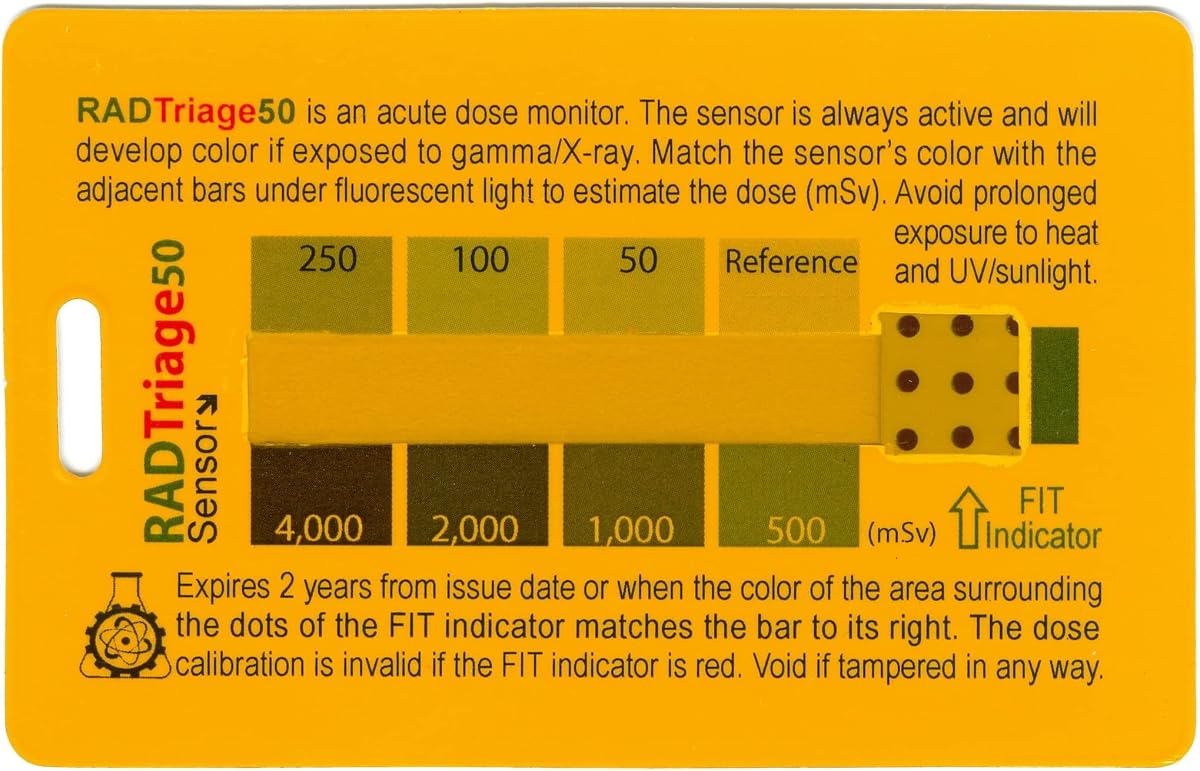
The Rad Triage 50 is a unique passive dosimeter designed for personal carry in a wallet or pocket. It requires no batteries or calibration, relying on chemical indicators to detect radiation exposure.
We may earn a commission when you buy through this link, at no additional cost to you.
Its strengths include military-grade field testing and approval by the US Department of Homeland Security. The device offers a long shelf life and is impervious to electromagnetic pulses, making it reliable for emergencies.
Because it is a passive detector, it does not provide real-time digital readings or alarms. Users must visually inspect the indicator bars after potential exposure to assess radiation levels.
This model is best suited for emergency preparedness kits where reliability and portability are paramount. It complements active detectors by providing a fail-safe backup option.
Without batteries or calibration needs, the device remains ready for use even after years of storage.
Shelf life can be extended up to ten years by storing in a freezer, ensuring readiness when needed.
We may earn a commission when you buy through this link, at no additional cost to you.
This detector offers a practical balance of portability and functionality at an affordable price. It features a clear LCD display and a reliable rechargeable battery for extended use.
We may earn a commission when you buy through this link, at no additional cost to you.
The triple alarm system ensures alerts are noticed through visual, audible, and red indicator light signals. It detects gamma, beta, and X-rays effectively for general monitoring tasks.
While it lacks some advanced features found in premium models, it covers all basic needs for radiation detection. The compact design makes it easy to carry in a shirt pocket during inspections.
Best for home improvement projects or casual monitoring, this unit provides solid performance without unnecessary complexity. It is a great choice for those needing a simple and effective tool.
With Type-C charging and up to eight days of battery life, you can rely on this device during extended field work.
Adjust alarm thresholds, modes, and units to tailor the device to your specific monitoring needs.
We may earn a commission when you buy through this link, at no additional cost to you.
The AEGTEST Radar-5633 provides a useful overview of radiation data on a single screen, reducing the need to toggle between modes. It offers solid performance for routine monitoring tasks.
We may earn a commission when you buy through this link, at no additional cost to you.
Key features include an 18-day battery life and a multi-data screen showing dose rate, count rate, and cumulative dose simultaneously. The blue design and clear display make it visually appealing.
Despite a lower user rating, it remains a cost-effective option for those needing basic detection capabilities. However, users may prefer models with more refined interfaces or higher precision.
This detector suits users who need a straightforward and economical tool for checking radiation levels. Its long battery life adds convenience for occasional use without frequent charging.
Ready to use as soon as it is powered on, with multiple data points visible without switching screens.
Custom alarm thresholds can be set to alert you when radiation levels exceed safe limits.
We may earn a commission when you buy through this link, at no additional cost to you.
This premium model utilizes a CsI scintillator sensor for superior precision and stability compared to traditional Geiger tubes. It is ideal for professionals needing reliable and accurate measurements.
We may earn a commission when you buy through this link, at no additional cost to you.
Features include a color screen with waveform curves and an impressive battery life of up to 70 days. The telescopic rod allows safe distance monitoring from radiation sources, enhancing user safety.
While more expensive, the device offers high accuracy and advanced features that justify the cost for serious users. It is particularly well-suited for laboratory or environmental monitoring applications.
Best for users requiring high-precision data, this model delivers professional-grade performance in a portable package. Its stable operation and detailed display make it a standout premium choice.
The CsI scintillator sensor resists interference better than traditional tubes for more stable and accurate readings.
Color screen includes dynamic waveform curves and dose rate bars for intuitive and detailed data viewing.
We may earn a commission when you buy through this link, at no additional cost to you.
The GMC-500Plus enhances accuracy with dual Geiger tubes and independent calibration factors. It pushes detection range limits significantly higher than single-tube models.
We may earn a commission when you buy through this link, at no additional cost to you.
Its large LCD with auto font display ensures readability, while onboard speaker and memory support audio and data logging. Unlimited server logging allows you to submit data to any server automatically.
Trade-offs include a slightly dated interface compared to newer color screen models. However, its robust sensor setup and logging capabilities make it a favorite among serious users.
Ideal for users who prioritize sensor redundancy and long-term data tracking, this model offers a reliable solution. Its extended detection range ensures comprehensive coverage for various scenarios.
Dual Geiger tubes provide enhanced accuracy and detection range compared to standard single-tube devices.
Unlimited server logging enables automatic submission of data to any server worldwide for real-time tracking.
We may earn a commission when you buy through this link, at no additional cost to you.
This detector features a versatile audio-visual-haptic alert system ensuring you notice warnings regardless of environment conditions. Its compact design includes a clip for easy carry on belts or pockets.
We may earn a commission when you buy through this link, at no additional cost to you.
With a runtime of up to 30 days and a clear TFT display, it offers practical daily use without constant charging. The sensor provides accurate detection for Beta, Gamma, and X-ray radiation.
While accuracy is good for most tasks, it may lack the extreme precision of premium models. However, its alert system and portability make it a strong choice for personal protection.
Best for individuals needing a reliable personal guardian against radiation threats, this model balances features and convenience. Its adjustable brightness ensures readability in various lighting conditions.
Immediate warnings via sound, light, and vibration ensure no detection goes unnoticed during critical moments.
Up to 30 days on a full charge makes this device practical for extended monitoring without frequent interruptions.
We may earn a commission when you buy through this link, at no additional cost to you.
This versatile tool covers a wide range of applications from home improvement to seafood and wastewater inspection. It offers a clear LCD display and a reliable rechargeable battery for daily use.
We may earn a commission when you buy through this link, at no additional cost to you.
Four alarm modes ensure alerts are clearly communicated through sound, vibration, alarm light, and screen display. The built-in GM sensor provides fast response time for quick detection of radiation levels.
Trade-offs include a somewhat basic feature set compared to high-end models. However, for general monitoring and inspection tasks, it provides sufficient functionality at an accessible price point.
Ideal for users needing a flexible and affordable detector for various environments, this model delivers solid performance. Its versatility makes it a practical choice for diverse radiation monitoring scenarios.
Widely applied in environments with ionizing radiation such as nuclear power plants, laboratories, and outdoor settings.
Four alarm modes ensure you are immediately notified of danger regardless of device state or environment.
We may earn a commission when you buy through this link, at no additional cost to you.
Choosing the right dosimeter depends on your specific needs, whether for professional use, hobbyist monitoring, or emergency preparedness. Understanding key factors helps you select a device that offers accuracy, reliability, and ease of use.
The sensor type significantly impacts accuracy and detection range. Geiger-Müller tubes are common and affordable, while scintillator sensors offer higher precision and stability for professional applications. Look for models that meet national standards like NIST or NRC to ensure reliable measurements.
Prioritize a sensor type that matches your usage needs and verify calibration standards for accurate readings.
A clear and intuitive display is essential for quick readings. Color LCD screens provide better visibility and data visualization, while large fonts help users with vision impairments. The interface should allow easy navigation between modes without complex menus.
Choose a display and interface that suit your environment and ensure readability in various lighting conditions.
Effective alarm systems alert you instantly to dangerous radiation levels. Models with multiple alert types including visual, audio, and vibration ensure warnings are noticed even in noisy or bright environments. Customizable alarm thresholds allow tailoring to your safety requirements.
Select a device with robust and customizable alarms to guarantee immediate awareness of radiation risks.
Long battery life is critical for extended monitoring tasks. Rechargeable batteries with Type-C charging offer convenience, while some passive models require no batteries at all. Consider models that support long-duration use without frequent recharging or replacement.
Opt for a power solution that aligns with your usage frequency and duration requirements to avoid interruptions.
Data logging features allow you to track radiation levels over time. Look for devices that store history data internally and support downloading to a computer for analysis. Cloud or server logging options can further enhance tracking capabilities for remote monitoring.
Ensure the device offers sufficient storage and data export options to meet your record-keeping needs.
Portability is key for personal monitoring or field work. Compact devices fit easily in pockets or wallets, while rugged builds withstand rough handling. Some models include accessories like telescopic rods or straps to enhance safety and ease of use.
Choose a build quality and size that fits your typical usage scenarios and physical requirements.
Certifications from recognized bodies like US national standards or military-grade testing provide confidence in device reliability. These ensure the device has been rigorously tested for accuracy and performance under various conditions.
Verify that the device meets relevant safety and accuracy standards for your intended application.
While budget is a consideration, prioritize value over low cost. Higher-priced models often offer better accuracy, features, and durability. Evaluate whether the additional cost justifies the performance gains for your specific needs.
Balance cost against essential features to find a device that offers the best long-term value for your requirements.
Before first use, charge the device fully and familiarize yourself with the user manual and settings. Ensure the alarm thresholds and display units are configured to your preferred safety standards and measurement preferences.
When measuring, hold the device steady and allow it a few seconds to stabilize readings. Avoid exposing the sensor to extreme temperatures or moisture unless the device is specifically rated for such environments to prevent damage.
Regularly update the device firmware if available and store it in a protective case when not in use. Keep the sensor area clean and avoid physical impacts that could compromise accuracy or internal components.
A dosimeter is a device that measures exposure to ionizing radiation such as beta, gamma, or X-rays. It uses sensors like Geiger-Müller tubes or scintillators to detect radiation particles and convert them into readable data for user monitoring.
Yes, many consumer dosimeters are designed for home use and provide accurate enough readings for general monitoring. Look for models certified to national standards and with positive user feedback to ensure reliable performance in domestic settings.
Active dosimeters typically require periodic calibration to maintain accuracy, whereas passive models like the Rad Triage 50 do not need calibration. Follow the manufacturer’s guidelines for calibration schedules to ensure ongoing device reliability.
Most dosimeters detect beta, gamma, and X-ray radiation, but neutron radiation requires specialized equipment. Check the product specifications to confirm the specific radiation types your chosen model can detect effectively.
Battery life varies by model, with some offering up to 70 days on a single charge while others may last only days. Rechargeable units with Type-C charging are common and provide convenient power management for extended use.
Yes, dosimeters are safe for everyday use and do not emit radiation themselves. They are passive or active measurement tools designed to monitor environmental radiation levels without posing any risk to users.
Many models support downloading data via USB or Type-C connections to a computer using provided software. This allows you to review historical exposure trends and share data for professional or personal analysis.
Active dosimeters provide real-time readings and often use rechargeable batteries, while passive dosimeters do not require power and must be read after exposure. Active units are better for continuous monitoring, while passive ones serve well for emergency preparedness.
Choosing the right dosimeter ultimately depends on your specific needs and the environment you plan to monitor. The GQ GMC-800 stands out as the top overall pick for its balance of accuracy, user-friendly interface, and comprehensive data features.
If you seek a budget-friendly option without sacrificing core functionality, the GMC-300S offers excellent value with solid performance. For professionals needing higher precision, the HFS-50-CsI provides superior sensor technology and reliable monitoring capabilities.
Remember that availability and product configurations may change over time, so always check the latest product information and current prices before purchasing. Select a device that fits your usage patterns and safety requirements for optimal peace of mind.