
Entina Tina2C
4.4Editor score
Designed specifically for kids beginners
Start printing in under 8 minutes
Access to large model library online
This guide compares the top 3D printers for educational use, focusing on ease of use, safety, and STEM learning features for classrooms and home schooling.
Finding the right 3D printer for educational use requires balancing ease of use with robust features. Students need reliable machines that foster creativity without constant technical troubleshooting or safety risks.
We evaluated ten top models based on calibration ease, print speed, safety certifications, and educational resources. Each product was analyzed for its suitability in classrooms or home learning environments.
Each pick highlights key strengths and limitations to help you decide quickly. Note that manufacturer pricing and inventory change frequently, so verify current availability before making your final selection today.
4.4Editor score

4.7Editor score

4.5Editor score
This comparison table allows you to quickly view the core specifications and ratings of all ten selected educational 3D printers side by side.





The Bambu Lab A1 stands out as an excellent choice for educational environments due to its robust automation and speed. It simplifies the printing process significantly, allowing students to focus on design rather than mechanics.
We may earn a commission when you buy through this link, at no additional cost to you.
Its full-auto calibration handles all tedious setup steps automatically, ensuring optimal performance for every print. The high-speed precision and active flow rate compensation deliver exceptional detail consistently.
While multi-color printing adds cost via the AMS lite, the standard unit remains highly capable for single-color projects. The quiet operation ensures it fits well in classrooms without causing distractions.
This printer is ideal for educators seeking reliability and speed without excessive technical overhead. It balances advanced features with user-friendly design effectively for both beginners and experts.
Automatic Z-offset and bed-leveling eliminate manual errors.
Lightning-fast printing lets you focus on creating, not waiting.
We may earn a commission when you buy through this link, at no additional cost to you.
The Entina Tina2C is designed specifically for first-time users and kids, making 3D printing simple and fun. Its compact size and guided setup via the Poloprint Cloud app reduce frustration significantly.
We may earn a commission when you buy through this link, at no additional cost to you.
Students can start printing in as fast as 8 minutes, which keeps engagement high during short class periods. The app offers AI features and a vast library to inspire creativity.
While the print volume is small, it is perfect for small educational builds and quick prototypes. Power-loss recovery ensures that interruptions do not ruin the learning experience or waste material.
This is an ideal budget option for home schooling or introductory classes. It balances ease of use with enough features to teach the basics of design and printing effectively.
Fully optimized for beginners to start creating immediately.
Access 20+ creative DIY modules and courses.
We may earn a commission when you buy through this link, at no additional cost to you.
The Snapmaker U1 offers true multi-material and mixed-material printing capabilities ideal for advanced educational projects. Its unique toolhead system automates swaps completely, reducing waste and time significantly.
We may earn a commission when you buy through this link, at no additional cost to you.
Students can create functional parts and articulated models in a single print using different materials. The speed and automation make it a powerful tool for engineering and prototyping courses.
While the initial investment is higher, the workflow efficiency and print quality justify the cost for dedicated programs. The large build volume supports complex structures that smaller printers cannot handle.
This printer is best for advanced workshops or specialized STEM labs. It provides professional-grade features that inspire deep learning and innovation in design.
Automatic tool changes reduce time from 2 minutes to 5 seconds.
Combines rigid and flexible materials easily for complex parts.
We may earn a commission when you buy through this link, at no additional cost to you.
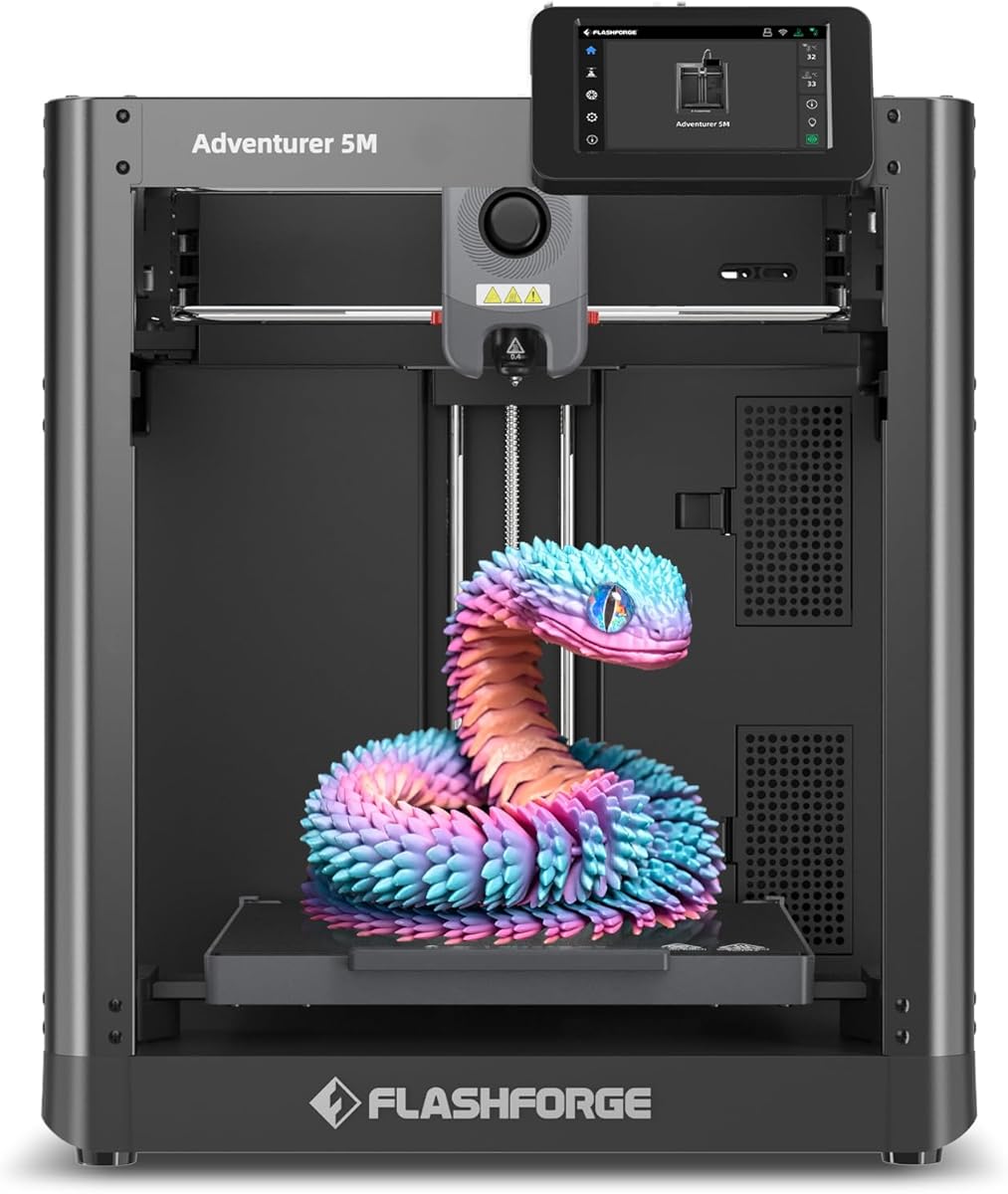
The FLASHFORGE Adventurer 5M offers high-speed performance ideal for rapid prototyping in educational settings. Its CoreXY structure ensures precision even at fast speeds, making it useful for busy labs.
We may earn a commission when you buy through this link, at no additional cost to you.
Features like automatic bed leveling and quick nozzle changes minimize downtime. Remote monitoring allows instructors to track progress without constant physical oversight.
While it lacks multi-color capabilities compared to competitors, it remains a robust choice for high-volume single-color tasks. The high extruder temperature supports a variety of filaments.
This model is suitable for schools needing speed and reliability. It provides a strong platform for teaching rapid design cycles and technical adjustments.
Max 600mm/s travel speed reduces production cycles significantly.
Real-time app monitoring allows seamless remote management.
We may earn a commission when you buy through this link, at no additional cost to you.
The Bambu Lab P1S is an excellent enclosed printer for educational use, improving performance for advanced materials. Its design ensures consistent results across various filament types.
We may earn a commission when you buy through this link, at no additional cost to you.
The quick setup time allows students to focus on creation rather than assembly. Automatic leveling ensures high-quality prints consistently without manual intervention.
While it supports engineering filaments like PET ABS, users should note that multi-color printing requires an additional AMS module. The speed remains impressive for most classroom tasks.
This printer is ideal for advanced engineering courses or diverse material classes. It offers reliability and enclosure safety in a single package.
Fully enclosed body improves print performance for advanced filaments.
Lightning-fast speed lets you focus on creating.
We may earn a commission when you buy through this link, at no additional cost to you.
The FLASHFORGE AD5M combines brand-new technology with superior craftsmanship to meet needs of all users. Its CoreXY structure ensures high-speed printing without compromising quality.
We may earn a commission when you buy through this link, at no additional cost to you.
Automatic leveling measures nozzle distance precisely for flawless first layers. Power outage recovery prevents lost progress, reducing frustration in classroom environments.
The tool-free nozzle swap simplifies maintenance for novices. While specific nozzle diameters are supported, this limits extreme precision options for some projects.
This model is great for general educational use and rapid prototyping. It balances speed, reliability, and ease of use effectively.
Automatic one-click leveling ensures accurate offsets every time.
Core XY structure ensures high-speed printing without compromising quality.
We may earn a commission when you buy through this link, at no additional cost to you.
The Bambu Lab P2S Combo delivers high-speed precision with seamless multi-color capabilities. It is perfect for showcasing creativity with vibrant multi-material prints.
We may earn a commission when you buy through this link, at no additional cost to you.
Features like filament drying and adaptive airflow improve success rates significantly. AI detection catches issues early, reducing waste and downtime in busy labs.
While the setup is quick, the cost is higher than single-unit printers. However, the multi-color functionality provides significant educational value for complex projects.
This machine is ideal for advanced STEM classes requiring visual complexity. It combines speed, reliability, and professional features in one package.
AMS 2 Pro enables seamless multi-color and multi-material printing.
Adaptive airflow system balances cooling and heat retention.
We may earn a commission when you buy through this link, at no additional cost to you.
The Ugee Funbox is designed as a 3D printer for kids, ensuring safety and ease of use. It features zero calibration technology, so children can print immediately after setup.
We may earn a commission when you buy through this link, at no additional cost to you.
AI tools allow kids to turn drawings or photos into 3D models instantly. This hands-on learning develops design thinking and spatial reasoning effectively.
While limited to single-color PLA, the safety features like HEPA filters and enclosures are excellent for classrooms. The built-in camera lets students share progress easily.
This is an outstanding gift or classroom tool for young learners. It prioritizes safety and engagement to foster creativity in a safe environment.
Anti-pinch door and safe shield keep little fingers protected.
AI engines turn text and photos into printable models.
We may earn a commission when you buy through this link, at no additional cost to you.
This version of the Adventurer 5M emphasizes speed and robust design. It uses Core XY motion to achieve maximum speeds with exceptional quality for most tasks.
We may earn a commission when you buy through this link, at no additional cost to you.
Vibration compensation eliminates ghosting, ensuring smooth surfaces. Filament run-out and power loss recovery protect against accidental interruptions during lessons.
While open design suits well-ventilated rooms, it may limit usage with certain high-temp materials. However, for general educational use it is reliable and fast.
This is a solid choice for schools needing speed and durability. It balances performance with accessible features for all users.
Core XY acceleration ensures fast speed without compromising quality.
Run-out sensor eliminates problems of empty spools during printing.
We may earn a commission when you buy through this link, at no additional cost to you.
The Bambu Lab A1 Mini Combo delivers high-speed precision in a compact form. Its quiet operation makes it perfect for shared learning spaces where noise control is key.
We may earn a commission when you buy through this link, at no additional cost to you.
Full-auto calibration handles setup automatically, allowing focus on creativity. Active flow rate compensation ensures consistent smooth prints regardless of complexity.
While the build volume is smaller, it is sufficient for many educational models. The multi-color capability expands what students can create with minimal extra effort.
This is an excellent choice for home classrooms or desktop labs. It balances size, speed, and ease of use effectively.
A1 Mini delivers blazing-fast printing with exceptional accuracy.
Setup takes just 20 minutes thanks to pre-assembled design.
We may earn a commission when you buy through this link, at no additional cost to you.
Selecting the right 3D printer requires balancing ease of use, safety, and learning features. This guide outlines the critical factors to consider.
Look for automatic bed leveling to minimize manual adjustments. Students benefit from machines that start reliably without complex calibration steps.
Higher speeds reduce wait times, keeping students engaged. Fast printers allow more iterations and learning cycles in limited class periods.
Enclosed bodies and low emissions are vital for classrooms. Features like anti-scald surfaces and air filtration ensure a safe environment.
Integrated apps and model libraries foster creativity. Software that offers STEM courses helps teach concepts beyond just printing objects.
Quiet operation prevents distractions during learning. Look for noise cancellation features to maintain a focused classroom atmosphere.
Check support for various filaments like PLA and TPU. Versatility allows students to experiment with different properties and applications.
WiFi and remote monitoring allow easier management. The ability to control or check printers from an admin device saves time.
Choose a size that fits your project needs. A larger volume supports bigger prototypes but may take up more space.
Begin by ensuring the printer is on a stable, level surface. Follow the manufacturer's instructions for initial setup to avoid calibration issues later.
Look for UL GREENGUARD certification and low-emission standards. These ensure the machine does not release harmful fumes. Additionally, check for enclosed designs and anti-scald features.
Multi-color printers can significantly enhance creative projects. However, standard single-color models are sufficient for learning basics. Consider your budget and project goals.
Auto-leveling is crucial for beginners as it ensures the first layer adheres correctly. Without it, failed prints can be frustrating. Prioritize printers with full auto-calibration.
Most printers support standard PLA. Some allow for specialized filaments like TPU or PETG. Check compatibility lists before purchasing materials.
Open-source slicers like Cura are popular. Some printers come with proprietary software optimized for their hardware. Choose based on the ease of use.
Regular cleaning and nozzle checks prevent clogs. Lubricate moving parts according to the manual. Store filament in a dry place to avoid moisture issues.
We reviewed ten top models balancing speed, safety, and ease of use. The Bambu Lab A1 and Entina Tina2C offer excellent starting points for different budgets.