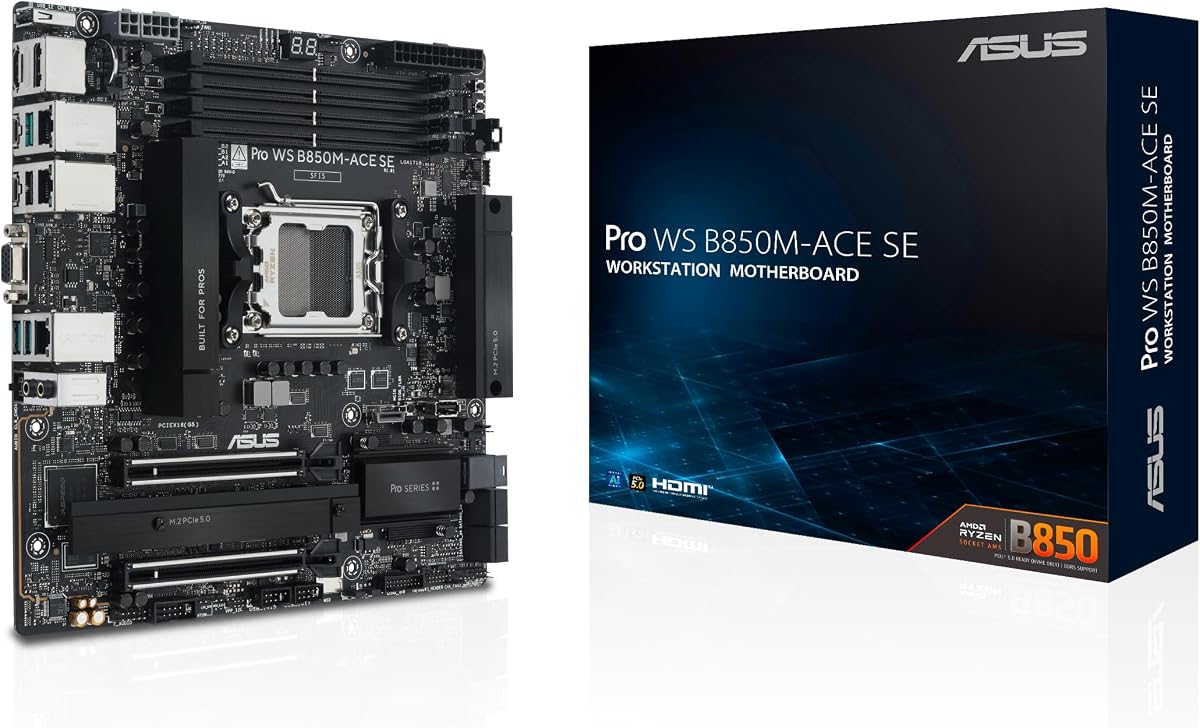
ASUS Pro WS B850M-ACE SE
4.3Editor score
AMD AM5 socket for Ryzen 9000 series
Compact microATX business form factor
10G and 2.5G LAN ports included
This guide compares the top ten ASUS server motherboards for enterprise workloads, AI computing, and data centers, highlighting connectivity and stability
ASUS server motherboards deliver enterprise-grade reliability and performance for demanding workloads. They support high-core CPUs, ECC memory, and robust networking essential for modern data centers and AI applications.
We compared ten models based on socket support, expansion slots, power delivery, and management features. Each board balances cost and capability for different server environments from compact workstations to large-scale racks.
Each pick highlights key specs, strengths, and trade-offs to help you choose wisely. Prices and availability change frequently, so verify current details before purchasing to ensure compatibility with your specific hardware needs.
4.3Editor score

3.7Editor score

5.0Editor score
This side-by-side comparison highlights the key specifications and capabilities of each ASUS server motherboard to help you identify the best fit for your specific infrastructure requirements.


The ASUS Pro WS WRX90E-SAGE SE is a high-end EEB workstation motherboard designed for AMD Ryzen Threadripper PRO 7000 WX-Series processors. With a 3.7 rating from users, it offers a powerful foundation for enterprise compute tasks requiring extensive I/O and memory bandwidth.
We may earn a commission when you buy through this link, at no additional cost to you.
This board features 32 power stages and seven PCIe 5.0 x16 slots, enabling multi-GPU setups and high-speed storage expansion. The inclusion of dual 10Gb LAN ports and 2TB ECC R-DIMM DDR5 support ensures reliability and connectivity for data center workloads.
While it supports only Threadripper PRO CPUs, its robust power delivery and thermal design maintain stability during long 24/7 operations. The PCIe Q-release Slim mechanism simplifies GPU installation without needing to press latches.
Experts recommend this board for users building scalable servers or workstations needing maximum PCIe lane availability. It balances advanced management features with the raw performance required for virtualization, rendering, and AI inference.
Server-grade IPMI remote management allows hardware-level control via a dedicated LAN port and AST2600 BMC controller for efficient server monitoring.
SlimSAS NVMe support alongside dual 10Gb LAN ports ensures the board can handle modern storage and networking demands effectively.
We may earn a commission when you buy through this link, at no additional cost to you.
The ASUS Pro WS W890E-SAGE SE is built for the future of AI computing with a perfect 5.0 rating from users. It targets Intel Xeon 600 processors and provides the connectivity needed for demanding AI applications in professional environments.
We may earn a commission when you buy through this link, at no additional cost to you.
Features include NitroPath DRAM technology to enhance memory performance and dual Intel E610-XAT2 10Gb LAN for reliable networking. The board includes innovative active cooling for VRM and chipset components to maintain stable performance under heavy loads.
While the premium pricing reflects its advanced features, the board's server-grade IPMI remote management ensures efficient maintenance. The support for 7 PCIe 5.0 x16 slots makes it ideal for complex multi-card configurations.
This motherboard is best suited for enterprises requiring high-end workstation capabilities with server-grade reliability. It stands out for its balance of future-proof connectivity and robust power delivery design.
The board is explicitly designed for advanced AI PC workloads, ensuring power and connectivity meet modern computational demands.
Real-time monitoring via ASUS Control Center Express and dedicated LAN port link to AST2600 BMC provides robust remote management.
We may earn a commission when you buy through this link, at no additional cost to you.
The ASUS Pro WS B850M-ACE SE delivers a cost-effective solution for next-gen AI workloads with a 4.3 user rating. Its compact microATX form factor makes it suitable for smaller business servers without sacrificing essential connectivity.
We may earn a commission when you buy through this link, at no additional cost to you.
It supports AMD Ryzen 9000 series and EPYC 4005 processors, offering robust performance for business tasks. The board includes two PCIe 5.0/4.0 x16 slots and front USB 20Gbps Type-C for versatile connectivity options.
Although it lacks the expansion of larger boards, it includes server-grade IPMI remote management via onboard BMC AST2600. This ensures that even compact builds maintain enterprise-level monitoring and control capabilities.
Experts recommend this model for budget-conscious users needing reliable server features in a smaller footprint. It balances affordability with necessary business features like dual LAN and NVMe support.
Built to power next-gen AI workloads with robust performance and a compact form factor suitable for tight server racks.
MCIO NVMe support and front USB 20Gbps Type-C provide high-speed data access and peripheral connectivity.
We may earn a commission when you buy through this link, at no additional cost to you.
The ASUS Pro WS W890-SAGE is designed for AI computing with a CEB form factor suitable for workstation environments. It targets Intel Xeon 600 processors and offers solid connectivity options for demanding applications.
We may earn a commission when you buy through this link, at no additional cost to you.
Key features include 7 PCIe 5.0 x16 slots and a mix of Realtek 10Gb LAN and Intel 2.5Gb LAN ports. The board supports ECC R-DIMM DDR5 memory with 2DPC configuration enhanced by NitroPath DRAM technology.
While it lacks onboard IPMI, it is ready for an IPMI expansion card to provide server-grade management. The thorough cooling ensures VRM and chipset components remain stable during 24/7 operation.
This board is ideal for users needing a balance between workstation flexibility and server stability. Its broad compatibility and robust power stages make it a reliable choice for custom server builds.
Designed for the future of AI computing with the power and connectivity needed for demanding AI applications.
Thorough cooling for VRM, chipset, and M.2 ensures sustained performance during intensive workloads.
We may earn a commission when you buy through this link, at no additional cost to you.
The ASUS Pro WS TRX50-SAGE WIFI supports up to 96-core CPUs and offers WiFi 7 connectivity for versatile networking. It is targeted at users needing robust workstation performance with built-in wireless capabilities.
We may earn a commission when you buy through this link, at no additional cost to you.
With a 36 power-stage design, it delivers stable power for high-end AMD Ryzen Threadripper PRO processors. The board supports up to 1TB ECC R-DIMM DDR5 memory and includes three PCIe 5.0 x16 slots for GPU expansion.
Despite its powerful specs, the user rating is slightly lower due to potential driver compatibility issues common with new wireless standards. However, the IPMI expansion support ensures it can function as a true server board.
Experts suggest this model for users requiring wireless flexibility alongside heavy computing power. It remains a strong option for environments where wired networks may not be feasible.
Built-in WiFi 7 ensures high-speed wireless connectivity without compromising the board's core server capabilities.
The massive 36 power-stage VRM design ensures stable power delivery for demanding multi-core processing tasks.
We may earn a commission when you buy through this link, at no additional cost to you.
The ASUS Pro WS TRX50-SAGE WiFi A is designed for the future of AI computing with a 4.0 rating. It supports AMD Ryzen Threadripper 9000 and 7000 WX-Series processors and offers a solid foundation for workstations.
We may earn a commission when you buy through this link, at no additional cost to you.
It features 20 power stages and three PCIe 5.0 x16 slots along with USB4 ports for high-speed data transfer. The board supports up to 1TB ECC R-DIMM DDR5 memory, making it suitable for virtualization and large datasets.
While the PCIe count is lower than the EEB models, it includes multi-GPU support and server-grade IPMI remote management. This ensures it can function reliably in managed environments.
Experts recommend this board for users needing a balance of performance and manageability. Its support for AI computing and robust power delivery make it a versatile choice for modern workloads.
Designed for the future of AI computing with the power and connectivity needed for demanding AI applications.
USB4 ports and SlimSAS NVMe support provide high-speed data access for modern storage and peripheral needs.
We may earn a commission when you buy through this link, at no additional cost to you.
The ASUS Pro WS W680-ACE IPMI is a compact ATX workstation motherboard supporting Intel 13th Gen Core processors. With a 4.4 rating, it offers a balance of modern features and server-grade management for small businesses.
We may earn a commission when you buy through this link, at no additional cost to you.
Key features include ECC memory support, dual PCIe 5.0 SafeSlots, and a bundled IPMI expansion card for remote management. The board also features a BMC header and Thunderbolt 4 header for versatile connectivity.
While it uses an older LGA1700 socket, its robust power solution ensures stable delivery. The large VRM heatsink and hybrid fan headers maintain system temperatures efficiently during operation.
Experts recommend this board for users needing enterprise features in a compact ATX case. Its combination of ECC support and IPMI management makes it a solid choice for critical workloads.
The bundled IPMI expansion card and BMC header enable hardware-level remote management and monitoring capabilities.
DrMOS, ProCool connector, and alloy chokes ensure stable power delivery for demanding workstation tasks.
We may earn a commission when you buy through this link, at no additional cost to you.
The Asus P12R-M/10G-2T is a dedicated server motherboard with Intel C252 chipset support for Xeon E-2300 processors. While rated N/A due to limited reviews, it offers a reliable platform for entry-level server deployments.
We may earn a commission when you buy through this link, at no additional cost to you.
Its Micro ATX form factor allows integration into compact server chassis. The board is designed for stability in server environments, prioritizing consistent performance over flashy consumer features.
Although it uses an older LGA1200 socket, it remains a solid choice for cost-sensitive projects requiring dedicated server reliability. It ensures compatibility with a wide range of existing Xeon processors.
Experts suggest this model for users needing a no-frills server board. Its simplicity and focus on stability make it a practical option for basic server tasks.
Built as a dedicated server motherboard with a specific chipset optimized for stable operation in data centers.
Micro ATX form factor ensures the board fits easily into compact server chassis without sacrificing core reliability.
We may earn a commission when you buy through this link, at no additional cost to you.
The ASUS Z13PE-D16 is an E-ATX server motherboard designed for dual Intel Xeon processors of the 5th Generation. Rated N/A, it offers massive RAM capacity and enterprise networking features for large data centers.
We may earn a commission when you buy through this link, at no additional cost to you.
It supports up to 16x DDR5 RDIMM slots for up to 4TB RAM, making it ideal for virtualization and heavy workloads. The board includes dual Intel 10Gbps Ethernet ports with teaming support for redundancy.
Features include built-in dual M.2 with PCIe 5.0 x4 bandwidth for faster OS booting. Its comprehensive management solution ensures IT administrators can control server operations efficiently.
Experts recommend this board for high-end server deployments requiring massive memory and networking. It provides the scalability needed for modern cloud and virtualization infrastructure.
Supports up to 4TB RAM across 16 DDR5 slots for extreme virtualization and data processing needs.
Dual 10Gbps Ethernet with teaming support ensures high-speed connectivity and network redundancy.
We may earn a commission when you buy through this link, at no additional cost to you.
The ASUS Pro WS W680-ACE IPMI offers a 2.6 rated entry-level ATX workstation with IPMI expansion bundled. It supports Intel 13th Gen Core processors and provides essential connectivity for small business use.
We may earn a commission when you buy through this link, at no additional cost to you.
It includes 3 PCIe 4.0 M.2 slots and dual Intel 2.5Gb Ethernet for versatile storage and networking. The IPMI expansion card provides a dedicated controller for BMC management capabilities.
While the user rating is lower, likely due to driver challenges, the board includes essential server features like HDMI, DisplayPort, and VGA outputs. It remains a practical choice for those needing IPMI on a budget.
Experts suggest this model for users needing basic server management in an ATX case. It balances cost with essential server capabilities like dual LAN and IPMI support.
The IPMI expansion bundle includes a dedicated Ethernet controller to provide intelligence for the IPMI architecture.
Dual Intel 2.5Gb Ethernet ensures stable networking while 3 M.2 slots provide ample storage expansion options.
We may earn a commission when you buy through this link, at no additional cost to you.
Choosing the right ASUS server motherboard requires balancing socket support, expansion capabilities, and management features to match your specific enterprise workload.
Verify the processor generation you plan to use. ASUS offers motherboards for Intel LGA 1700, LGA 4710-2, and AMD sTR5 sockets. Select a socket that matches your desired CPU architecture to ensure compatibility and performance.
Check the QVL list to confirm your specific CPU model is supported. This prevents potential issues with BIOS compatibility or unstable operation.
Count the number of PCIe slots and their version. High-performance AI and rendering tasks need multiple PCIe 5.0 x16 slots. Server applications may require M.2 or SlimSAS slots for NVMe storage.
Review the layout to ensure cards fit without blocking airflow. Larger EEB boards offer more slots than compact ATX models.
Determine your RAM needs. Workstation boards often support ECC R-DIMM DDR5 up to 1TB or 2TB. Server boards like the Z13PE-D16 support up to 4TB for heavy virtualization.
Verify memory speed support and channel configuration. Faster memory improves performance for compute tasks and database applications.
Assess required LAN speeds. Enterprise setups often need dual 10Gb LAN ports. Entry-level boards may offer dual 2.5Gb ports. Some models include USB4 for high-speed peripheral connectivity.
Look for NICs from Intel or Realtek depending on your OS compatibility needs. High-end models often support teaming for redundancy.
Server-grade IPMI remote management allows hardware-level control and monitoring. Ensure the board includes a dedicated BMC or header for an expansion card.
ASUS Control Center Express software enhances monitoring. Verify the management features match your administrative workflow needs.
Choose between EEB, CEB, ATX, or MicroATX based on your case size. Larger boards allow better cooling and more expansion slots. Active VRM cooling is vital for 24/7 operations.
Check heatsink coverage on M.2 slots and VRM. Good cooling ensures stability during sustained heavy loads.
Verify the number of power connectors required. High-power boards need multiple 8-pin CPU and PCIe power connectors. Dual PSU operation may be needed for critical servers.
Ensure your PSU can handle the power stage requirements. Inadequate power leads to instability or shutdowns.
Compare features against cost. Premium models cost more but offer better reliability and support. Budget options may lack advanced features like IPMI.
Balance immediate needs with future-proofing. Investing in PCIe 5.0 may save costs later as hardware evolves.
Install the motherboard in a compatible case first ensuring standoffs are correctly placed. Connect power and data cables securely to avoid loose connections that cause instability during operation.
Update the BIOS to the latest version immediately after assembly. This ensures compatibility with newer CPUs and security patches. Use USB ports for BIOS updates if the OS does not boot.
Set up IPMI remote management early for efficient monitoring. Configure BIOS settings for stability and verify memory training. Ensure airflow is sufficient to cool VRM and M.2 heatsinks.
It depends on the form factor. ATX boards fit standard cases but EEB or CEB boards require larger chassis. Check case dimensions and mounting points before purchasing.
ECC memory detects and corrects data corruption automatically. This ensures system stability and data integrity during long 24/7 server operations.
Some workstation models include WiFi 7 built-in. Server models generally require an expansion card or rely on LAN for network connectivity.
IPMI allows you to manage the server remotely including BIOS settings and power control. It is essential for unattended maintenance in enterprise environments.
High-end workstation boards often have 7 PCIe 5.0 x16 slots. Entry-level boards may have 2 or 3 slots depending on the chipset and budget.
Usually you need to enable above 4G decoding and Resizable BAR. These settings optimize GPU communication for AI applications.
Without IPMI you may miss hardware errors until physical inspection. Using ASUS Control Center Express helps detect issues early.
The ASUS Pro WS WRX90E-SAGE SE and W890E-SAGE SE lead in expansion and AI performance. Budget options like the B850M-ACE SE offer essential features for smaller deployments.
Prioritize PCIe 5.0 slots and IPMI management to ensure scalability. Select a socket that matches your planned CPU generation to avoid compatibility issues later.
Prices fluctuate frequently so verify current pricing and availability. Ensure your case and power supply match the motherboard requirements before finalizing your build.