
Zoom H1 XLR 2-Channel Recorder
4.5Editor score
Two XLR inputs included
32-bit float recording
OLED waveform display
Compare the top audio field recorders for film to find the best device for capturing high quality sound on set or in demanding location environments today.
Finding the right audio field recorder for film is critical for capturing clean dialogue and ambient sound without distortion or noise interference on set.
We compared ten professional and semi professional models based on input options, recording formats, timecode capabilities, and overall reliability for filmmaking workflows.
Each pick highlights specific strengths and trade offs so you can choose the best tool for your budget and production needs while prices may fluctuate online.
4.5Editor score

4.7Editor score
4.6Editor score
This side by side comparison shows the key specifications and features of every model reviewed to help you quickly identify the right recorder for your specific production requirements.



The Zoom F6 Professional Field Recorder stands out as a top tier choice for filmmakers who need reliability and flexibility in the field. It holds a strong rating from users who praise its ability to capture whisper quiet dialogue and explosive sound without clipping thanks to 32-bit float recording. This model is designed for complex setups where you might need to connect multiple microphones simultaneously while ensuring your audio stays perfectly synchronized with your video footage.
We may earn a commission when you buy through this link, at no additional cost to you.
One of the most significant strengths of this recorder is its six XLR inputs which allow you to record multiple sources at once. This is essential for on set recording where you may have boom mics, lavaliers, and ambient mics all running at the same time. The built-in timecode I/O keeps your audio locked to the camera or external timecode generator which saves hours of effort during post-production editing. Additionally the ultra-portable design means you can take it anywhere without compromising on build quality or power options.
While this recorder offers professional grade features there are trade-offs to consider. The price is higher than entry-level models which might be a barrier for solo creators or those just starting out. There is also a learning curve associated with managing multiple tracks and timecode settings if you are new to field recording. However these factors are acceptable given the level of control and safety it provides for critical shoots where you cannot afford to lose audio.
If you are working on professional productions or demanding location work the Zoom F6 is the right choice for you. It balances power with portability and ensures you never miss a critical take due to clipping or sync issues. For filmmakers who need a standalone recorder that can also function as a USB interface this model delivers exceptional value and performance across a wide range of scenarios.
The 32-bit float recording ensures that even sudden loud noises or very quiet whispers are captured without distortion or loss of detail.
Timecode I/O allows your audio to remain frame-accurate with video which simplifies editing and reduces the risk of sync drift.
We may earn a commission when you buy through this link, at no additional cost to you.
The Zoom H1 XLR 2-Channel Recorder brings professional-quality recording capabilities to a budget-friendly package that is perfect for independent filmmakers. It boasts a solid rating from users who appreciate its ability to record in 32-bit / 96kHz for clear and detailed sound. This model is ideal for interviews podcasts and everyday recording where you need reliable performance without breaking the bank. The addition of two XLR inputs allows you to connect external microphones directly which is a major upgrade from standard consumer recorders.
We may earn a commission when you buy through this link, at no additional cost to you.
Its standout feature is the OLED waveform display which makes it incredibly easy to monitor your audio levels at a glance. This visual feedback helps you ensure clean recordings without needing to rely solely on headphones which is useful in noisy environments. The two XLR/TRS combo inputs let you connect microphones instruments and more for versatile setups that adapt to your specific needs. Additionally the support for SDXC cards up to 1TB gives you plenty of space for extended sessions and high-quality recordings.
While this unit offers impressive value it does have limitations compared to higher-end models. It lacks timecode support which might be a drawback for multi-camera setups or complex post-production workflows. The number of inputs is limited to two which means you cannot record multiple sources simultaneously without additional hardware. However these trade-offs are acceptable for those who prioritize simplicity and affordability over advanced features and flexibility.
If you need a simple setup that delivers pro-quality results without a steep price tag this recorder is an excellent choice for you. It is perfect for beginners or solo creators who want to improve their audio quality quickly and efficiently. Whether you are recording interviews or on-set dialogue this model provides the clarity and reliability you need to make your content sound professional.
The OLED display provides a clear view of your audio levels so you can adjust quickly without fumbling with menus or settings.
Two combo inputs let you plug in a variety of microphones and instruments easily expanding your recording options significantly.
We may earn a commission when you buy through this link, at no additional cost to you.
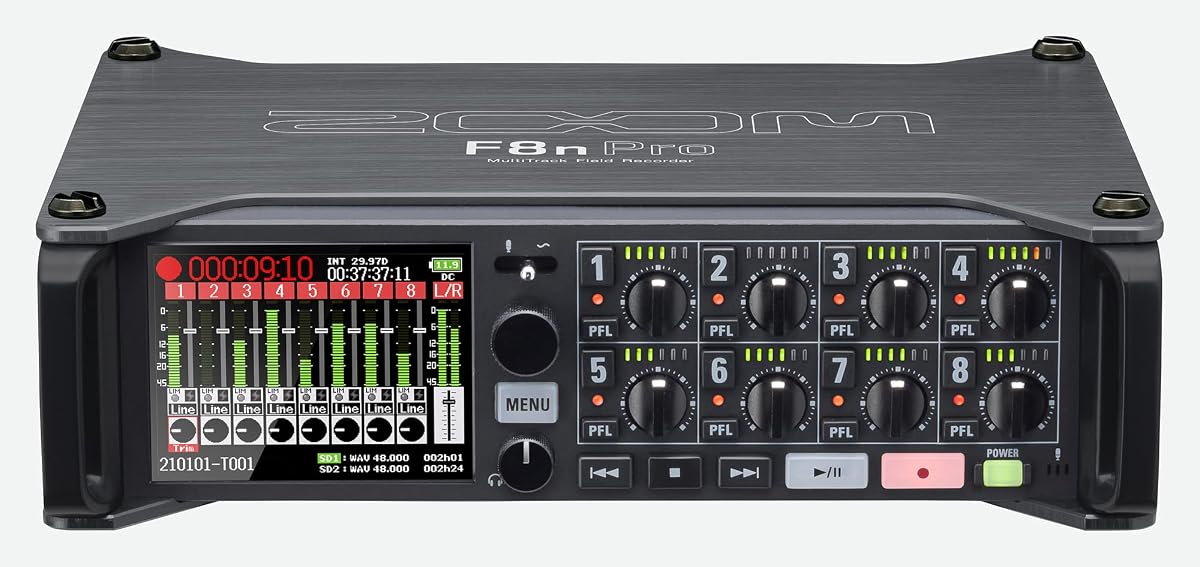
The Zoom F8n Pro Field Recorder is the choice for professional film and field audio that demands the highest level of performance and reliability. Users rate it highly for its ability to capture clip-free audio across the full dynamic range using 32-bit float and dual AD converters. This model is designed for complex setups where you need to connect multiple microphones simultaneously while ensuring your recordings are safe and synchronized. It offers eight channels and ten tracks which provides immense flexibility for capturing every element of a scene accurately.
We may earn a commission when you buy through this link, at no additional cost to you.
One of its key strengths is the industry-leading timecode accuracy provided by the TCXO which keeps your tracks perfectly aligned with picture on or off set. This is crucial for professional workflows where sync drift can ruin a take or create hours of post-production headaches. The dual SD card slots support redundant recording which means you can backup your footage instantly without stopping the take. Additionally the unit can function as an 8-in/4-out USB audio interface allowing you to use it seamlessly with your computer for monitoring and mixing.
While this recorder offers unmatched capabilities there are trade-offs to consider. The price is significantly higher than entry-level models which may not be feasible for all projects. The menu system can be complex for new users who are not familiar with advanced audio recording concepts. However these factors are acceptable given the level of control and safety it provides for critical shoots where audio quality is non-negotiable.
If you are working on professional productions or complex location work this model is the right choice for you. It balances power with reliability and ensures you never miss a critical take due to clipping or sync issues. For filmmakers who need a standalone recorder that can also function as a USB interface this model delivers exceptional value and performance across a wide range of scenarios.
The 32-bit float recording ensures that even sudden loud noises or very quiet whispers are captured without distortion or loss of detail.
Timecode accuracy down to 0.2ppm allows your audio to remain frame-accurate with video which simplifies editing and reduces the risk of sync drift.
We may earn a commission when you buy through this link, at no additional cost to you.
The Zoom F3 Professional Field Recorder is built for real-world recording where there are no second chances on professional sets or in demanding conditions. It has earned a strong rating from users who appreciate its ability to capture everything from quiet dialogue to sudden peaks without stopping to adjust levels. This recorder is ideal for run-and-gun filmmakers who need a reliable tool that can handle unpredictable environments without compromising on audio quality. The compact design makes it easy to carry while the dual locking XLR inputs keep connections secure when mounted out of reach.
We may earn a commission when you buy through this link, at no additional cost to you.
One of its key strengths is the use of 32-bit float recording which ensures clean consistent audio even when conditions aren't controlled. The ultra-low-noise preamps provide the clarity needed for professional work while the flexible power options keep you recording without interruption during long days on set. It also supports standalone or USB workflows which gives you the freedom to use it in a variety of setups. This flexibility makes it a versatile tool for both solo creators and larger production teams.
While this recorder offers excellent performance for portable work it does have limitations. It only has two XLR inputs which may not be enough for complex rigs requiring multiple microphones. It is not designed for large scale productions where you need to manage many inputs simultaneously. However these trade-offs are acceptable for those who prioritize mobility and reliability over extensive channel counts and advanced routing options.
If you need a recorder that can handle real-world challenges without needing constant adjustment this model is the right choice for you. It is perfect for documentary filmmaking independent projects and run-and-gun scenarios. Whether you are recording interviews or on-set dialogue this model provides the clarity and reliability you need to make your content sound professional.
Built to withstand demanding conditions this recorder ensures you never miss a take due to equipment failure or environmental factors.
Dual locking XLR inputs keep your cables secure even when the recorder is mounted in hard-to-reach places during active shoots.
We may earn a commission when you buy through this link, at no additional cost to you.
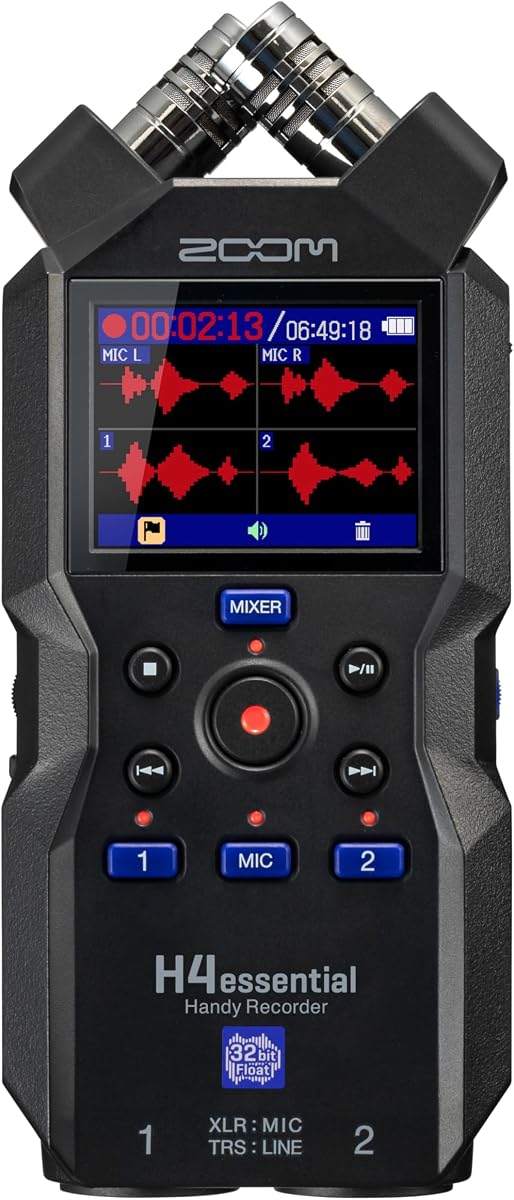
The Zoom H4 Essential Handheld Recorder is designed to help you capture bigger projects with confidence without worrying about distorted takes. It holds a solid rating from users who use it for music interviews podcasts and live performances where clarity is key. This model is ideal for creators who need a 4-track recorder that can handle detailed audio for songs videos and field recordings. The built-in stereo microphones are convenient but you can also connect external mics or instruments via two XLR/TRS inputs for more versatility.
We may earn a commission when you buy through this link, at no additional cost to you.
One of its standout features is the ability to record to your device and SD card simultaneously. You can connect to your phone tablet or computer with USB-C for recording or streaming while saving a backup directly to the SD card. This ensures you never lose critical audio even if one medium fails. Additionally the spoken menu guidance makes the device easier to use for visually impaired users and anyone who wants a more guided experience navigating through settings.
While this unit offers great flexibility for creative work it does have limitations compared to professional units. It lacks some advanced features like timecode which might be necessary for film sync workflows. The spoken menu might be distracting for some users who prefer silent operation. However these trade-offs are acceptable for creators who prioritize ease of use and flexibility over specialized film features and routing options.
If you need a versatile tool for creative work that is easy to navigate this recorder is the right choice for you. It is perfect for independent filmmakers podcasters and musicians who want high-quality audio without complex setups. Whether you are recording interviews or on-set dialogue this model provides the clarity and reliability you need to make your content sound professional.
Recording to USB and SD card at once ensures your critical audio is never lost due to file corruption or device failure.
Spoken menu guidance makes navigation easier for everyone ensuring that setting up your recorder is straightforward and stress-free.
We may earn a commission when you buy through this link, at no additional cost to you.
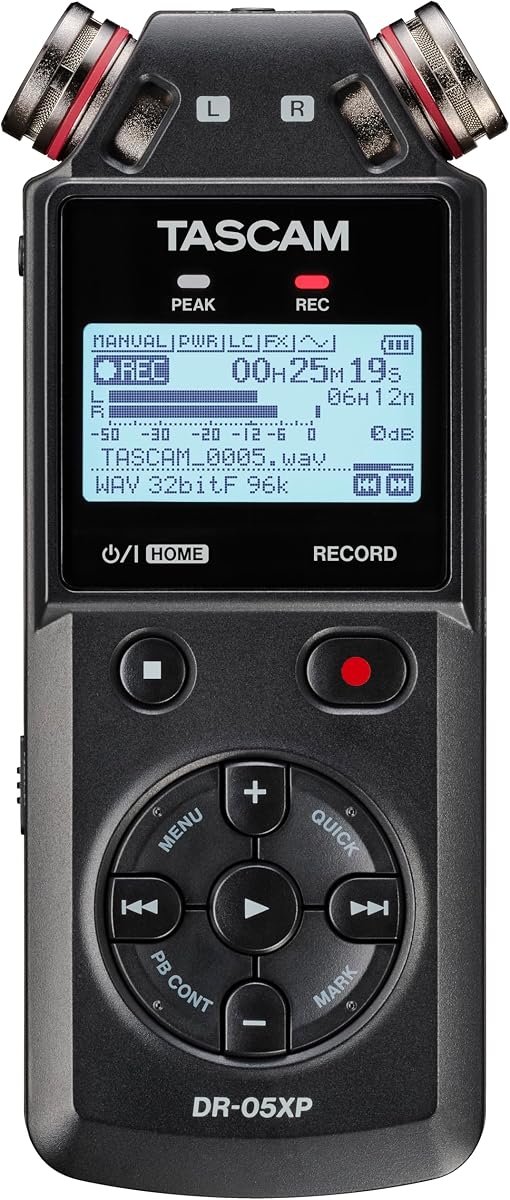
The TASCAM DR-05XP portable handheld recorder makes it easy to capture pro-quality recordings for music audio-for-video and meetings without requiring external equipment. It has a good rating from users who appreciate its flexible recording modes including 32-bit float options for high fidelity sound. This model is ideal for quick capture scenarios where you need to record ambient sound or interviews without setting up complex gear. The omnidirectional condenser microphones handle loud environments well which ensures consistent audio quality even in noisy settings.
We may earn a commission when you buy through this link, at no additional cost to you.
One of its key strengths is the 2-in/2-out USB-C audio interface which allows you to record directly to your computer. This makes it a versatile tool for both field recording and home production workflows. The battery life is impressive offering up to 17.5 hours of operation on AA alkaline batteries which is perfect for extended sessions. It also supports various bit rates and sample rates giving you the flexibility to choose the format that best suits your project needs.
While this unit offers great portability it does have limitations for complex film work. It lacks external XLR inputs which means you must rely on built-in mics or adapters. There is also no timecode support which might be a drawback for syncing with video. However these trade-offs are acceptable for those who prioritize portability and ease of use over advanced connectivity and film synchronization features.
If you need a lightweight tool for quick capture scenarios this recorder is the right choice for you. It is perfect for journalists students and content creators who want high-quality audio without complex setups. Whether you are recording interviews or on-set dialogue this model provides the clarity and reliability you need to make your content sound professional.
With support for multiple bit rates and sample rates you can choose the format that best suits your project needs and storage constraints.
The battery life ensures you can record for extended sessions without interruption which is crucial for long interviews or events.
We may earn a commission when you buy through this link, at no additional cost to you.
The Zoom H5 4-Track Handheld Recorder is a versatile tool that uses a system of interchangeable input capsules that can be swapped out as easily as the lens of a camera. It has a high rating from users who appreciate its flexibility for capturing different types of audio sources. This model is ideal for filmmakers and musicians who need a 4-track recorder that can adapt to different recording situations. The included detachable X/Y capsule provides extended signal capacity and shock mounted mics for reduced handling noise which is critical for clean on-set recordings.
We may earn a commission when you buy through this link, at no additional cost to you.
One of its key strengths is the inclusion of two mic/line inputs with XLR/TRS combo connectors each with selectable phantom power. This allows you to connect a wide range of microphones and instruments without needing extra adapters. The four-track simultaneous recording ensures you can capture multiple sources at once for full production flexibility. Additionally it functions as a multichannel and stereo USB audio interface for PC/Mac/iPad with Loop Back function which makes it useful for streaming and remote production.
While this recorder offers great flexibility it does have limitations compared to newer models. It lacks 32-bit float recording which means you need to monitor levels more carefully to avoid clipping. The design is older and may not have some modern features like USB-C or spoken menus. However these trade-offs are acceptable for those who prioritize modularity and proven reliability over the latest digital recording features.
If you need a modular tool that can adapt to different recording needs this recorder is the right choice for you. It is perfect for independent filmmakers podcasters and musicians who want high-quality audio without complex setups. Whether you are recording interviews or on-set dialogue this model provides the clarity and reliability you need to make your content sound professional.
Interchangeable capsules let you swap out microphone capsules easily to suit different recording scenarios from stereo to surround sound.
Two combo inputs let you plug in a variety of microphones and instruments easily expanding your recording options significantly.
We may earn a commission when you buy through this link, at no additional cost to you.
The TASCAM DR-10L Pro Field Recorder is a complete personal recording solution that supports LTC Jam Sync for seamless timecode synchronization ideal for multi-device setups. It has a solid rating from users who value its ability to capture superior personal audio with worry-free recording thanks to 32-bit float recording. This model is ideal for filmmakers who need a stealthy recorder that can be worn on the body while still providing professional-quality fidelity. The included TM-10L clip-on lavalier microphone is perfectly matched to deliver clear lifelike audio even in busy settings.
We may earn a commission when you buy through this link, at no additional cost to you.
One of its key strengths is the support for high-capacity microSDXC media cards which provides practically limitless storage for your recordings. You can record up to 512GB of audio which means you can capture extended sessions without changing cards. Additionally the Connect App allows you to take command of up to 5 simultaneous recordings which is useful for larger production workflows. Firmware updates have added support for Atomos Wireless Timecode which further integrates it into professional setups.
While this recorder offers great convenience it does have limitations for large scale work. It is a wearable unit which limits the number of inputs and may not be suitable for complex rigs. Battery dependence means you need to monitor power levels carefully during long shoots. However these trade-offs are acceptable for those who prioritize personal audio capture and timecode integration over multi-channel recording capabilities.
If you need a personal tool for stealthy recording this recorder is the right choice for you. It is perfect for interviews documentaries and content creators who want high-quality audio without complex setups. Whether you are recording interviews or on-set dialogue this model provides the clarity and reliability you need to make your content sound professional.
Support for high-capacity microSDXC cards ensures you can record for extended periods without needing to swap media frequently.
LTC Jam Sync keeps your audio synchronized with video which simplifies editing and reduces the risk of sync drift during post.
We may earn a commission when you buy through this link, at no additional cost to you.
The Zoom H1 Essential Recorder is designed to help you capture clear stereo audio for videos reels tutorials and behind-the-scenes clips that need more polished sound than a phone alone. It has a good rating from users who use it to record real-world sound like ambience nature and travel audio for music production and documentation. This model is ideal for content creators who need a simple tool to improve their audio quality quickly without complex setups. It also allows you to connect via USB-C and use it as a microphone for livestreams remote meetings and voiceovers.
We may earn a commission when you buy through this link, at no additional cost to you.
One of its key strengths is its readiness when inspiration hits allowing you to record songwriting sessions rehearsals and live music with detailed sound easily. The clear voices feature helps voices come through clearly for podcast episodes lectures and meetings. Additionally it records directly to SDHC cards which is convenient for quick file access. The compact design makes it easy to carry in a bag or pocket so you can capture audio whenever the moment arises.
While this recorder offers great ease of use it does have limitations for professional film work. It lacks XLR inputs which means you must rely on built-in mics or adapters for external microphones. There is also no timecode support which might be a drawback for syncing with video. However these trade-offs are acceptable for those who prioritize portability and simplicity over advanced connectivity and film synchronization features.
If you need a simple tool for quick capture scenarios this recorder is the right choice for you. It is perfect for independent filmmakers students and content creators who want high-quality audio without complex setups. Whether you are recording interviews or on-set dialogue this model provides the clarity and reliability you need to make your content sound professional.
The ready-to-use design ensures you never miss a creative moment with quick setup and reliable performance in the field.
Optimized for speech this recorder ensures voices come through clearly for podcasts lectures and interviews without distracting noise.
We may earn a commission when you buy through this link, at no additional cost to you.
The Zoom F2 Lavalier Recorder is the smallest 32-bit float recorder you can wear which captures clip-free audio at any volume level without needing to adjust gain. It has a solid rating from users who appreciate its ability to record at 44.1kHz or 48kHz without ever needing to adjust levels. This model is ideal for filmmakers journalists and content creators who need a discreet recorder for interviews vlogs and on-camera recordings. The included LMF-2 omnidirectional lavalier microphone features a screw-lock connector windscreen and lapel clip for secure placement.
We may earn a commission when you buy through this link, at no additional cost to you.
One of its key strengths is the power efficiency running up to 15 hours on just 2 AAA batteries which makes it one of the most power-efficient recorders available. It supports microSD cards up to 512GB providing ample storage for long-form recordings film shoots and extended field sessions. The REC Hold switch prevents accidental stops during critical recordings while the precision clock ensures perfect audio and video sync for professional film and video production. These features make it a reliable tool for long events and continuous shoots.
While this recorder offers great convenience it does have limitations for multi-microphone setups. It is a single-channel wearable unit which limits its use for complex rigs requiring multiple inputs. It is not designed for large scale productions where you need to manage many inputs simultaneously. However these trade-offs are acceptable for those who prioritize personal audio capture and ease of use over multi-channel recording capabilities.
If you need a wearable tool for discreet recording this recorder is the right choice for you. It is perfect for interviews documentaries and content creators who want high-quality audio without complex setups. Whether you are recording interviews or on-set dialogue this model provides the clarity and reliability you need to make your content sound professional.
This device fits discreetly on a subject while ensuring clip-free audio at any volume without manual gain adjustments during recording.
Running up to 15 hours on AAA batteries ensures you can record for extended sessions without needing to change power sources often.
We may earn a commission when you buy through this link, at no additional cost to you.
Selecting the right recorder involves balancing features with your specific production needs and budget constraints.
The number of XLR inputs you need depends on your typical setup. For simple interviews or solo runs a two input recorder is sufficient. For larger productions with multiple mics you will need four eight or more inputs to capture all elements simultaneously.
Choose a recorder with enough inputs to handle your most complex typical scenario so you do not miss any critical audio sources.
Modern recorders offer 32-bit float recording which ensures you never clip even if audio levels fluctuate wildly. This feature simplifies gain staging significantly. If your device supports this format it should be a priority especially for unpredictable environments.
Prioritize 32-bit float support to ensure clean audio without constant manual adjustments during critical recordings.
For professional film workflows having timecode I/O is essential for syncing audio with video accurately. Look for recorders with built-in timecode generation or external sync ports. This ensures your audio stays frame-accurate during editing.
Choose a model with robust timecode features to avoid sync drift issues in post-production.
If you are working in the field you need a recorder that is rugged and portable enough to withstand travel. Consider the size weight and battery life of the device. Some models are designed specifically for handheld use while others are better suited for mounting in rigs.
Select a recorder that balances build quality with portability to ensure it works reliably on location.
Storage capacity can significantly impact how long you can record without interruption. Look for models that support high capacity SDXC cards or have dual slots for redundancy. This ensures you can capture long sessions safely without swapping media.
Ensure your recorder supports large capacity cards or has multiple slots to protect your data.
Modern recorders should offer flexible connectivity like USB-C for direct connection to computers or streaming devices. This allows you to use the unit as an interface for mixing or backup. Check if it supports both standalone recording and interface modes for versatility.
Choose a unit with USB-C support to integrate seamlessly with your digital workflow.
Balance your budget against the features you need. High-end models offer extensive inputs and timecode but may be overkill for simple projects. Entry-level models are affordable but may lack critical features like multiple inputs or advanced recording formats.
Identify your must-have features to find a recorder that fits your budget without compromising on quality.
The user interface should be intuitive enough to navigate quickly during recording. Look for features like clear displays spoken menus or simplified controls. A complex menu system can cause delays or errors in fast-paced environments.
Select a recorder with a user-friendly interface to ensure smooth operation during takes.
Always start by testing your levels with the actual microphones and environment before recording. Use the waveform display to ensure your signal is clean without clipping or too quiet.
Keep your device in a protective case when not in use to prevent damage from drops or moisture. Store SD cards in a dry place and regularly backup your files to avoid data loss.
Clean your inputs and microphone grilles periodically to remove dust and debris. Ensure your batteries are fully charged and carry spares for long sessions to avoid unexpected shutdowns.
32-bit float recording captures audio with an extremely wide dynamic range. It ensures that even if your levels are set too high or too low during recording you can recover the audio without distortion in post-production. This makes it ideal for field recording where conditions are unpredictable and gain adjustment is not possible.
Timecode provides a precise timestamp for your audio files which allows you to sync them accurately with video footage. Without it you would have to manually align audio and video which is time-consuming and prone to error. For professional film work having built-in timecode support is essential for efficient workflows.
The number of inputs you need depends on your typical setup. If you mostly record interviews or solo runs two inputs are sufficient. If you record scenes with multiple microphones or a small crew you will need four or more inputs to capture all sources simultaneously without losing quality.
Many modern field recorders can function as USB audio interfaces for computers. This allows you to use them for live streaming direct recording to a laptop or monitoring during post-production. Check your device specifications to confirm it supports USB-C connectivity and interface modes.
Most field recorders use either AA batteries or rechargeable battery packs. For long sessions it is best to use high quality rechargeable batteries to save money and reduce waste. Always carry spares and ensure you have a reliable charging solution for remote locations.
Some recorders come with built-in microphones which are suitable for ambient sound and basic interviews. However for professional results you will likely need external XLR microphones like lavaliers or boom mics. Check if your device supports phantom power if you plan to use condenser microphones.
The best way to protect your recordings is to use a recorder with dual SD card slots for redundancy. If your recorder does not have this feature make sure to backup your files regularly to an external drive. Always carry extra memory cards and format them properly before shooting.
Many modern recorders support USB-C or Bluetooth connectivity that allows them to connect to smartphones for streaming or remote control. This is useful for live broadcasts or quick file transfers. Check your device compatibility before planning to use it with mobile devices.
We have reviewed ten top models ranging from the versatile Zoom F6 to the budget friendly Zoom H1 XLR. Each offers distinct strengths depending on your production scale and requirements.
Prioritize features like 32-bit float recording and timecode if you need professional quality. For simpler tasks portability and ease of use should take precedence.
Remember to verify current pricing and availability as these factors can change. Selecting the right tool will ensure your audio is as polished as your visuals.