
RIGOL DHO924S
4.5Editor score
250 MHz bandwidth
12-bit resolution
Built-in signal generator
Digital oscilloscopes are essential tools for engineers and hobbyists who need to visualize and analyze electrical signals. They provide a graphical display of voltage changes over time, allowing for precise measurements and troubleshooting in various electronic projects.
We evaluated ten leading models based on bandwidth, channel count, sampling rate, display quality, and additional features like built-in signal generators. Our comparison focuses on performance, usability, and value to help you find the ideal instrument for your specific needs.
Each pick highlights key strengths and potential trade-offs to guide your decision-making process. Keep in mind that product availability and pricing can fluctuate, so verify current details before purchasing to ensure you get the best deal available.
4.5Editor score

4.9Editor score

4.4Editor score
As an Amazon Associate we earn from qualifying purchases.
The following table provides a side-by-side overview of all ten models, highlighting their core specifications to help you quickly identify the right fit for your application.
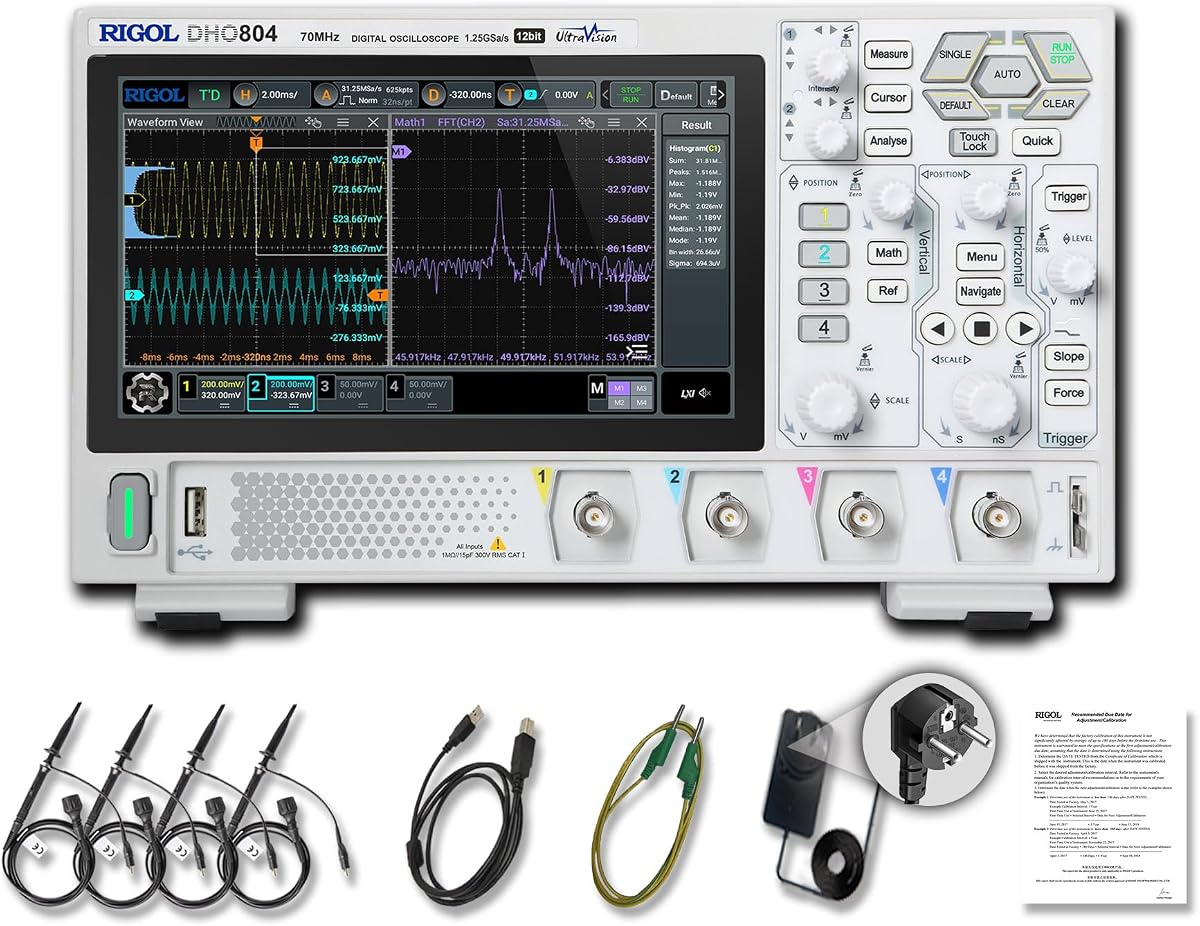


The RIGOL DHO804 stands out as a versatile tool for professionals who need detailed signal analysis without excessive cost. It earns a solid 4.3 star rating from users who appreciate its high-resolution display and intuitive touch interface.
We may earn a commission when you buy through this link, at no additional cost to you.
Its 12-bit vertical resolution provides significantly more detail than standard 8-bit scopes, allowing you to see small voltage variations clearly. The four analog channels enable simultaneous monitoring of multiple signals, which is crucial for complex embedded systems and power supply testing.
While the 70 MHz bandwidth may not suit ultra-high-speed applications, it covers most industrial and educational needs effectively. The deep memory depth ensures you can capture long sequences without sacrificing sample rate, preserving signal integrity over time.
Engineers and educators looking for a balanced mix of performance and usability will find this model ideal. It bridges the gap between basic hobbyist tools and expensive laboratory instruments with ease and precision.
The 12-bit resolution reveals subtle noise and ripple that 8-bit scopes often miss, improving diagnostic accuracy.
Touch controls and auto-measurements reduce setup time, letting you focus on analysis rather than configuration.
We may earn a commission when you buy through this link, at no additional cost to you.
The RIGOL DHO924S is a powerhouse for advanced testing, offering 250 MHz bandwidth and a built-in arbitrary function generator. Users rate it highly for its ability to handle complex debugging tasks in embedded and power electronics environments.
We may earn a commission when you buy through this link, at no additional cost to you.
Key strengths include the ability to perform Bode plot analysis directly on the device, which simplifies loop stability testing. The 50 Mpts memory depth allows for capturing rare events without compromising sample rate, ensuring no data is lost.
While it comes at a premium price, the integration of generation and analysis tools saves bench space and cost compared to buying separate units. The remote control features also facilitate automated testing workflows in production or research labs.
This unit is best suited for professionals who demand top-tier performance and need an all-in-one solution for signal validation and troubleshooting.
Combining scope and generator functions streamlines bench setups, reducing cable clutter and setup time for iterative tests.
Bode plots and FFT options provide deep insights into frequency response and signal integrity without external software.
We may earn a commission when you buy through this link, at no additional cost to you.
The FNIRSI DPOS350P combines an oscilloscope, spectrum analyzer, frequency response analyzer, and signal generator into one portable unit. It appeals to users needing high bandwidth and multifunctional tools at a competitive price point.
We may earn a commission when you buy through this link, at no additional cost to you.
Its standout feature is the frequency response analysis capability, which is rare at this price level. This makes it particularly useful for tuning analog filters and testing loop stability without specialized equipment.
Users should note the two-channel limitation compared to four-channel models, which might restrict complex multi-signal debugging. However, for field technicians and smaller labs, the portability and battery life offer significant advantages.
This model is an excellent choice for those who need versatility and high bandwidth but have budget constraints or require field mobility.
Four tools in one device reduce the need for multiple instruments, saving space and investment for small workshops.
Built-in battery support allows for uninterrupted use in remote locations or during mobile maintenance tasks.
We may earn a commission when you buy through this link, at no additional cost to you.
The RIGOL DS1102Z-E is a classic choice known for its reliability and deep memory capabilities. With a near-perfect user rating, it remains a favorite for education and general electronics troubleshooting.
We may earn a commission when you buy through this link, at no additional cost to you.
Its deep memory allows for capturing long signal sequences at high sample rates, which is critical for analyzing intermittent glitches or rare events. The inclusion of serial decoding for protocols like I2C and SPI adds significant value for embedded developers.
While it lacks a touch screen, the physical button layout is robust and preferred by many users who dislike accidental touches during measurements. The interface is straightforward and easy to learn for beginners.
This scope is ideal for students and hobbyists who prioritize function and reliability over modern interface features.
Widely used in universities, it offers a stable platform for learning oscilloscope fundamentals and measurement techniques.
High waveform capture rates help reveal rare transient issues that might otherwise go unnoticed during standard monitoring.
We may earn a commission when you buy through this link, at no additional cost to you.
The FNIRSI 2C53T merges oscilloscope, multimeter, and signal generator functions into a single compact device. It is designed for users who need basic measurement capabilities without carrying multiple instruments.
We may earn a commission when you buy through this link, at no additional cost to you.
The multimeter function supports voltage, current, and resistance measurements, making it a true all-in-one diagnostic tool. Users appreciate the ability to store waveforms and images via USB-C for later analysis or reporting.
Bandwidth is limited to 50 MHz, which restricts its use to lower-frequency analog or digital signals. However, for basic maintenance and educational purposes, it provides sufficient resolution and stability.
This model is best for hobbyists and field technicians who need a lightweight solution for routine checks and signal verification.
Replacing three tools with one unit significantly reduces the weight and space required in a toolkit or bench.
Easy image export allows for quick documentation of faults or setups for sharing with colleagues or clients.
We may earn a commission when you buy through this link, at no additional cost to you.
The FNIRSI DSO152 is arguably the most affordable handheld oscilloscope available. It targets hobbyists and students who need basic waveform visualization for low-frequency circuits like audio or Arduino projects.
We may earn a commission when you buy through this link, at no additional cost to you.
Its auto setup feature simplifies measurement, allowing users to capture signals without manual parameter tuning. The battery life supports up to four hours of continuous use, making it suitable for field inspections.
Bandwidth is limited to 200 kHz, which means it cannot measure high-speed digital signals. However, for DC and low-frequency AC checks, it performs reliably and offers excellent value for money.
This unit is perfect for beginners learning electronics or professionals needing a quick backup tool for basic continuity and signal checks.
Low cost lowers the barrier to entry for learning oscilloscope basics without investing in expensive gear immediately.
Its tiny size fits in a pocket, ensuring you always have a visual tool available when troubleshooting on the go.
We may earn a commission when you buy through this link, at no additional cost to you.
The Hantek DSO2D15 offers a balanced mix of features including arbitrary waveform generation and 150 MHz bandwidth. It is well-regarded for its versatility in both lab and industrial settings.
We may earn a commission when you buy through this link, at no additional cost to you.
With fourteen trigger modes and standard protocol decodes, it handles complex signal analysis tasks with ease. Users appreciate its ability to generate custom waveforms for testing system responses directly.
While the physical build and menu navigation may feel less polished than premium brands, the functional performance is robust. It provides a cost-effective alternative for users needing more than basic measurement capabilities.
This model is suitable for mid-level users who need specific advanced features without paying for top-tier brand premiums.
Extensive trigger options allow precise capture of complex events, improving signal integrity analysis accuracy.
Offers capabilities like arbitrary waveforms at a price point that undercuts many competitors in the market.
We may earn a commission when you buy through this link, at no additional cost to you.
The FNIRSI 1013D Plus stands out with its large seven-inch touchscreen and robust storage capabilities. It is designed for users who prefer a graphical interface for easier operation and data management.
We may earn a commission when you buy through this link, at no additional cost to you.
It supports up to 1000 sets of waveform data storage, making it easy to review past measurements later. The high voltage tolerance ensures safety when testing mains or industrial signals, adding a layer of protection.
While some advanced features rely on software integration, the standalone hardware is capable and responsive. The Lissajous and FFT viewing modes provide additional insight into signal composition.
This scope is a strong choice for those prioritizing user interface and data storage features in a mid-range device.
A large touchscreen simplifies navigation and cursor placement, making measurements faster and more intuitive.
Built-in storage allows you to keep a library of test results without needing external computers immediately.
We may earn a commission when you buy through this link, at no additional cost to you.
This model is listed in the top ten but lacks specific product details in our current database. It may be a newer release or a variant with limited public specification data available at this time.
We may earn a commission when you buy through this link, at no additional cost to you.
We recommend visiting the product page directly to verify bandwidth, channel count, and other critical specifications before purchase. This ensures compatibility with your specific testing requirements.
As with any electronic purchase, checking recent user reviews can provide insights into real-world performance and reliability.
Proceed with caution and verify all technical details to ensure this unit meets your expectations for quality and utility.
Always double-check the latest product listings for updated technical details and feature sets before buying.
We may earn a commission when you buy through this link, at no additional cost to you.
This final listing in our comparison also lacks specific product data. It may represent an older model or a variant that has been updated with new technical information recently.
We may earn a commission when you buy through this link, at no additional cost to you.
We advise readers to visit the provided link to confirm the most current specs, pricing, and availability. Comparing these details with your needs is essential for making an informed decision.
User feedback often fills gaps left by technical manuals, so reading reviews can be particularly helpful for these entries.
Verify product details thoroughly to ensure it aligns with your project requirements and budget constraints.
Checking current product listings ensures you have the latest information on performance and compatibility.
We may earn a commission when you buy through this link, at no additional cost to you.
Choosing the right digital oscilloscope requires balancing technical specifications with your specific needs and budget constraints.
Bandwidth determines the highest frequency signal the scope can accurately measure. It is recommended to choose a scope with at least three times the bandwidth of your highest frequency signal to maintain signal integrity.
Always select a scope with bandwidth well above your maximum signal frequency to ensure accurate measurements.
Sample rate refers to how many samples per second the scope captures. Higher rates ensure you do not miss fast transitions or glitches in digital circuits.
Aim for a sample rate at least four to five times your bandwidth to prevent aliasing and capture detailed waveforms.
The number of analog channels dictates how many signals you can view simultaneously. Two-channel models are sufficient for basic work, while four channels allow complex timing comparisons.
Choose four channels if you need to compare timing across multiple parts of a circuit simultaneously.
Memory depth determines how long you can capture a signal at high sample rates. Deeper memory allows longer acquisitions without losing detail, which is crucial for debugging intermittent issues.
Look for scopes with deep memory to capture long sequences without sacrificing sample rate.
USB, LAN, or HDMI ports allow you to save data and automate tests. Remote control via SCPI commands is vital for production testing environments.
Ensure the scope supports standard interfaces like USB or LAN for easy data transfer and automation.
A high-resolution screen with intensity grading helps visualize signal density and noise. Touch screens simplify interaction but may be prone to accidental input.
Prioritize high-resolution displays with clear contrast for better waveform visualization.
Built-in signal generators or multimeters save space and cost. Decoding protocols like I2C or SPI can save hours of manual analysis.
Consider integrated tools like signal generators if you frequently need stimulus signals alongside measurements.
Battery-powered handheld models are essential for field work or remote sites. Desktop models offer more power but lack mobility.
Select a battery-powered model if you need to take measurements away from a fixed lab bench.
Before connecting probes, ensure the scope is calibrated and grounded properly. Use a standard calibration signal to verify the probes are compensated correctly for accurate voltage readings.
When measuring high voltages, always use probes rated for the expected voltage. Never exceed the maximum input ratings to prevent damage to the device and ensure personal safety.
Store your oscilloscope in a cool, dry environment to protect sensitive electronics. Regularly update firmware to access new features and security patches.
Bandwidth refers to the frequency range the scope can measure, while sample rate is how often it captures data points. You need high bandwidth for high-frequency signals and high sample rate to capture fast transitions accurately.
Two channels are usually enough for basic voltage and timing checks. Four channels are recommended if you need to compare multiple signals simultaneously, such as in embedded systems or power electronics.
Yes, digital scopes work well for analog circuits. They often include features like persistence mode or infinite persistence which help visualize noise and signal density in analog waveforms.
Most scopes come with basic probes included. However, for high-voltage or high-frequency measurements, you may need specialized probes. Always check the bundle details before purchasing.
Deep memory allows the scope to store more waveform data points. This enables longer captures without reducing sample rate, which is critical for analyzing rare glitches or long-duration events.
Use USB or LAN connections to link the scope to a PC. Most brands provide software for remote control and data export. Check the product specs for specific compatibility with your operating system.
We have reviewed ten top digital oscilloscope models ranging from affordable handheld tools to advanced laboratory instruments. Each offers unique strengths depending on your bandwidth needs and feature requirements.
Prioritize bandwidth and channel count based on your typical projects. If you need advanced analysis tools like FFT or serial decoding, look for models that integrate these features directly.
Always verify current availability and pricing before buying to ensure you get the best value for your investment. Choosing the right tool now will serve you well for years of precise measurements.