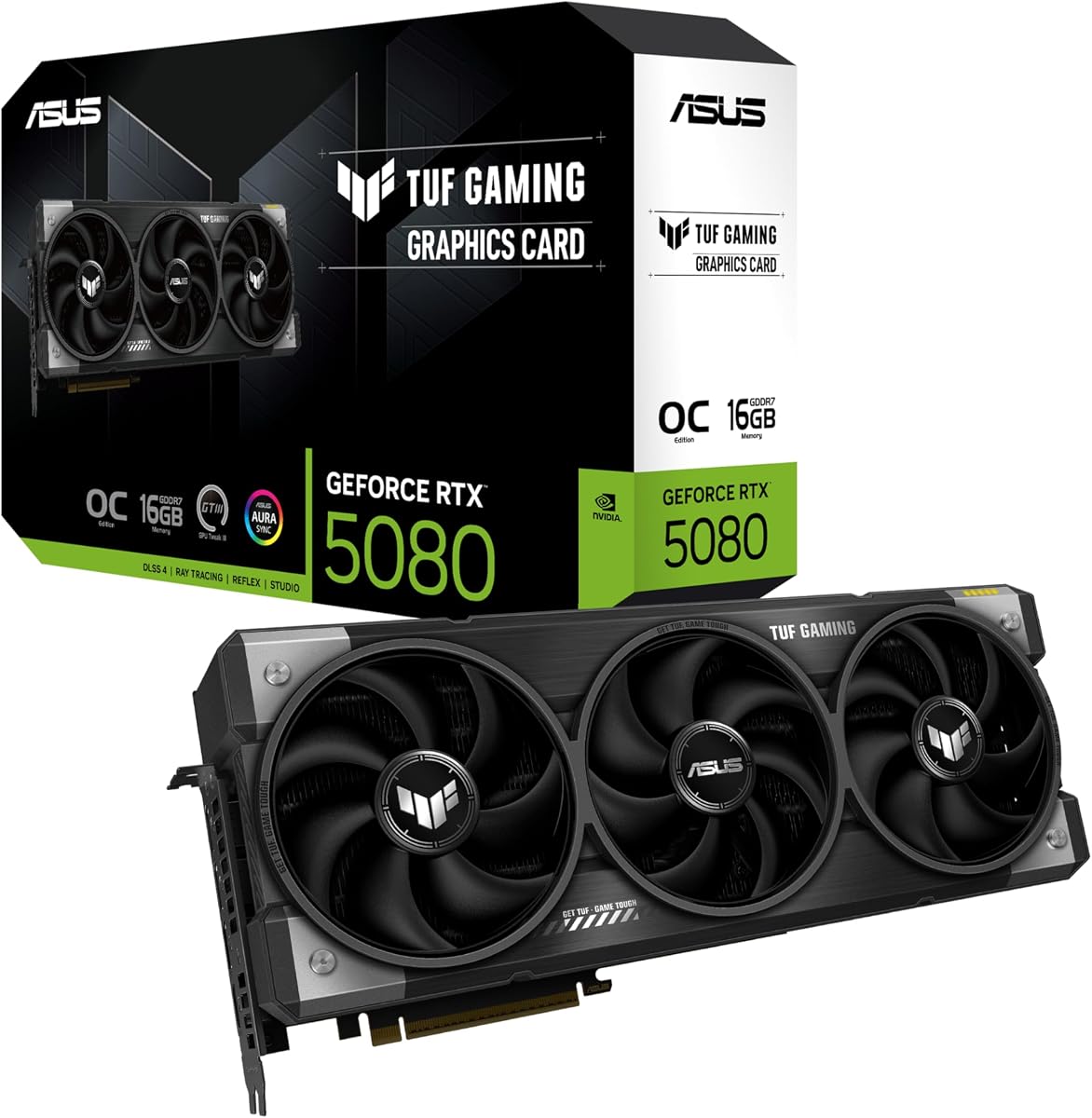
ASUS TUF Gaming RTX 5080
4.6Editor score
16GB GDDR7 Memory
Blackwell Architecture
Robust Cooling Design
This guide compares the top GPUs for Comfyui workflows, evaluating memory, cores, and architecture to help you choose the right hardware for stable diffusion.
Choosing the right GPU for Comfyui is essential for running local AI art generation smoothly. You need enough memory for large models and fast cores for quick image rendering without errors.
We compared ten leading graphics cards using real world performance data and architectural specs. Each pick highlights key strengths like memory bandwidth, tensor core speed, and overall compatibility with diffusion pipelines.
Every entry shows detailed pros, cons, and expert analysis to guide your decision. Note that availability and stock levels change often, so verify current options before placing your order.
4.6Editor score

4.3Editor score

4.7Editor score
The table below offers a side-by-side view of the top ten GPUs. Review memory sizes, architecture types, and core counts to find the best match for your Comfyui setup.


The NVD RTX PRO 6000 Blackwell stands out as a top tier GPU for Comfyui with its 96GB DDR7 memory and professional features. It delivers exceptional performance for large scale diffusion tasks with 5th gen tensor cores.
We may earn a commission when you buy through this link, at no additional cost to you.
Its double-flow-through design ensures sustained performance under heavy loads while PCIe gen 5 provides fast data transfer. The MIG feature allows secure isolation for multi user workflows or complex node setups.
Trade-offs include the high price and export regulations which limit availability. These are acceptable for enterprises needing reliability but might be too much for casual users.
Buyers needing maximum VRAM and enterprise features should consider this card. It represents the ultimate hardware for professional local AI production pipelines.
96GB of memory enables loading multiple SDXL models simultaneously without swapping.
MIG allows secure partitioning of resources for different Comfyui workflow instances.
We may earn a commission when you buy through this link, at no additional cost to you.
The ASRock Intel Arc Pro B60 Creator offers 24GB of VRAM at a competitive price point. It uses Intel Xe2-HPG architecture with XMX engines optimized for AI acceleration tasks.
We may earn a commission when you buy through this link, at no additional cost to you.
ISV certification means validated drivers for professional software. PCIe 5.0 support ensures future bandwidth needs are met. Scalable multi GPU support allows expansion later if needed.
The blower style cooling is efficient but can be loud under load. Driver support has improved but may still lag behind NVIDIA for niche Comfyui nodes.
Budget conscious professionals needing more VRAM will find this a smart pick. It balances cost and memory well for serious local AI work.
24GB capacity handles larger batch sizes and complex workflow chains.
Optimized for Linux deployments allowing easy scaling across multiple cards.
We may earn a commission when you buy through this link, at no additional cost to you.
This ASUS Dual card brings 16GB GDDR7 memory to Comfyui at a strong price. The Blackwell architecture supports DLSS 4 and offers 767 AI TOPS for faster inference.
We may earn a commission when you buy through this link, at no additional cost to you.
Its 2.5 slot design fits in tight cases without sacrificing cooling. 0dB tech stops fans during light use for silent operation. Dual BIOS toggles between quiet and performance profiles.
Overclocking can generate heat requiring good case airflow. Fewer ports mean fewer monitors compared to workstation cards.
Enthusiasts needing compact performance should choose this model. It delivers excellent speed for the size and price.
GDDR7 bandwidth and AI TOPS reduce image generation times significantly.
0dB fan control ensures silence during low load Comfyui checks.
We may earn a commission when you buy through this link, at no additional cost to you.
The GIGABYTE RTX 5080 offers 16GB of GDDR7 memory for robust Comfyui performance. Its WINDFORCE cooling system with three fans keeps thermals low during extended runs.
We may earn a commission when you buy through this link, at no additional cost to you.
PCIe 5.0 ensures future proofing for data transfers. The 256-bit interface provides high bandwidth for complex model loading. DLSS 4 support enhances visual tasks.
Its size requires a large chassis and powerful PSU. Power draw is significant for sustained inference loads.
Users seeking high raw speed with enough VRAM will appreciate this card. It balances performance and cooling well for desktop rigs.
WINDFORCE system maintains boost clocks under heavy Comfyui processing.
PCIe 5.0 ensures compatibility with next gen CPU data lanes.
We may earn a commission when you buy through this link, at no additional cost to you.
ASUS TUF Gaming brings rugged construction to Comfyui with military grade components. The 16GB GDDR7 memory handles models well with high clock speeds up to 2730MHz.
We may earn a commission when you buy through this link, at no additional cost to you.
Phase-change thermal pads ensure longevity under load better than paste. Auto-Extreme manufacturing improves reliability. GPU Tweak III offers detailed system monitoring.
Its weight and length may stress motherboard slots. Power requirements are high for sustained workloads.
Longevity focused buyers will find this reliable. It supports heavy workloads with robust internal parts.
Military grade parts extend life of the card under daily use.
Phase-change pads maintain performance over years of rendering.
We may earn a commission when you buy through this link, at no additional cost to you.
This GIGABYTE card delivers 16GB VRAM at a lower cost. WINDFORCE cooling with server grade thermal gel keeps temperatures in check.
We may earn a commission when you buy through this link, at no additional cost to you.
PCIe 5.0 support helps bandwidth. RGB lighting allows personalization. Good for general AI workloads.
Comfyui often optimizes best with NVIDIA CUDA cores. AMD may need extra config for smooth workflows.
If price is key and you handle setup, try this card. It offers good memory for the cost.
Server-grade gel ensures consistent heat transfer during long sessions.
WINDFORCE design maximizes airflow for stable performance.
We may earn a commission when you buy through this link, at no additional cost to you.
This budget card offers 16GB GDDR6 for Comfyui at an affordable price. 0dB tech ensures silence during light loads. Dual BIOS switches between performance profiles.
We may earn a commission when you buy through this link, at no additional cost to you.
Its compact design fits small cases easily. Axial tech fans provide effective cooling without noise.
AMD may not support all Comfyui node features out of box. CUDA is still standard for AI pipelines.
Budget buyers needing large memory should check this. It offers high capacity for minimal investment.
0dB tech stops fans during low load tasks for quiet.
Toggle between quiet and performance BIOS with one switch.
We may earn a commission when you buy through this link, at no additional cost to you.
This ASUS TUF card brings 12GB GDDR7 to Comfyui with Blackwell efficiency. Protective PCB coating resists moisture and dust damage. Phase-change thermal pads ensure longevity.
We may earn a commission when you buy through this link, at no additional cost to you.
Military-grade components provide stability. GPU Tweak III helps manage performance easily.
12GB might limit large SDXL workflows compared to 16GB. Still solid for most use cases.
Those valuing durability over raw memory capacity should consider this. It supports steady inference.
Coating shields against moisture and dust inside case.
Phase-change pads outlast paste for consistent cooling.
We may earn a commission when you buy through this link, at no additional cost to you.
This SFF card fits small chassis with 8GB GDDR6. Blackwell architecture supports newer AI features. Dual BIOS allows performance tuning.
We may earn a commission when you buy through this link, at no additional cost to you.
Compact design is perfect for home setups. 0dB tech ensures silent operation.
8GB limits model sizes significantly. May need cloud or external tools for heavy workloads.
Users with small cases need basic tasks can use this. It is entry level for Comfyui.
2-slot design fits in compact cases easily.
Blackwell architecture brings DLSS 4 to entry cards.
We may earn a commission when you buy through this link, at no additional cost to you.
PNY offers a compact RTX 5060 with 8GB GDDR6. It comes factory overclocked for boost clocks. VelocityX software allows fine tuning of clocks.
We may earn a commission when you buy through this link, at no additional cost to you.
Dual fans manage heat well in small cases. Blackwell architecture supports latest features.
Memory limits model sizes similar to other entry cards. Good for basic testing.
Buyers needing a reliable brand in small form factor may choose this. It is steady for entry workflows.
Factory boost clock provides extra performance without setup.
VelocityX offers detailed fan and clock control.
We may earn a commission when you buy through this link, at no additional cost to you.
Selecting a GPU requires balancing memory, speed, and budget. This section explains key factors influencing performance.
VRAM is crucial for loading large diffusion models. Aim for at least 16GB for complex workflows without swapping.
More memory enables batch generation and larger image sizes.
GDDR7 offers higher bandwidth than GDDR6 for faster data transfer. This impacts generation speed in Comfyui.
Prioritize cards with newer memory standards for better efficiency.
Tensor cores accelerate AI inference. NVIDIA RTX cards have strong support for Comfyui.
Check for latest gen cores like Blackwell or Xe2 for best performance.
PCIe 5.0 provides double bandwidth over Gen 4. This reduces data bottlenecks.
Future proof systems benefit from Gen 5 support.
Proper cooling maintains boost clocks. Look for multi-fan designs.
Efficient cooling ensures consistent performance during long runs.
Higher performance requires higher wattage. Verify PSU capacity before purchase.
Efficient cards reduce electricity costs and heat.
Comfyui works best with NVIDIA CUDA. AMD requires extra configuration.
Check official driver support for stability.
Ensure case clearance matches GPU length. Compact designs suit SFF builds.
Verify slot width before buying.
Install latest drivers from manufacturer website to ensure Comfyui compatibility. Use management tools like GPU Tweak for monitoring.
Keep case airflow clear to avoid overheating. Clean dust from fans every few months.
Avoid overclocking beyond stable limits. Stable performance prevents workflow crashes.
At least 16GB is recommended for most SDXL workflows. 24GB+ is ideal for large models. 8GB may struggle with advanced tasks.
NVIDIA cards offer native CUDA support which simplifies setup. AMD requires more configuration. NVIDIA is generally preferred.
It helps with faster data transfer to the GPU. Gen 4 works but Gen 5 reduces bottlenecks. Future proofing.
Multi-fan designs with high airflow keep temps low. Blower cards are compact but louder. Choose according to case.
Yes but setup varies. NVIDIA supports multi GPU. AMD may need Linux. Ensure driver compatibility.
Use tools like GPU Tweak or MSI Afterburner. Check real-time clocks and temperatures.
Our top picks cover a range of budgets and needs. The RTX PRO 6000 leads with massive memory for pros.
Prioritize memory capacity and cooling for stable local AI. Avoid entry cards if you plan to scale.
Check current prices and stock before buying. Availability changes quickly due to demand.