
RC Cellmeter 7 Digital Battery Capacity Checker Controller Tester
4.6Editor score
Lightweight and compact design
Displays total and cell voltages
Supports LiPo and NiMH packs
This guide compares the top 10 Li Ion Battery Tester models for 2026, analyzing accuracy, features, and value to help you choose the right device.
Finding the right Li Ion Battery Tester is crucial for maintaining rechargeable power sources. These devices ensure your batteries perform safely and efficiently. A quality tester provides precise data on capacity, voltage, and health metrics.
We evaluated ten top-rated models based on accuracy, ease of use, and versatility. Our list covers options for hobbyists, professionals, and general household needs. Each product was selected for its reliability and distinct feature set.
Each pick highlights key strengths, pros, and cons to simplify your decision. Prices and availability change frequently, so verify details before purchasing. This guide helps you invest in a tool that meets your specific testing requirements.
4.6Editor score

4.7Editor score

4.4Editor score
The following table provides a side-by-side overview of the ten selected models. Compare their key specifications and capabilities to find the best fit for your needs.




This 18650 Lithium Battery Capacity Tester Module offers a detailed look at your battery health with a 4.3 rating. It allows users to monitor capacity, internal resistance, and voltage simultaneously across four channels. The integration of charge and discharge capabilities streamlines the process of evaluating individual cells.
We may earn a commission when you buy through this link, at no additional cost to you.
The device supports a wide capacity measurement range and displays real-time power and current data. This makes it suitable for enthusiasts who need to verify battery performance before installation. The 1.77 inch screen provides clear visibility of all critical metrics during the testing cycle.
Users should note that the measurement error is approximately 10 percent, which may not suit high-precision industrial applications. Additionally, obtaining the user manual requires contacting the seller directly. Despite these minor hurdles, the module provides robust functionality for hobbyists.
This tester is ideal for those managing multiple 18650 batteries for projects or storage. It simplifies the workflow by eliminating the need to disassemble equipment for testing. We recommend it for users seeking a comprehensive module at a reasonable price point.
Testing four channels simultaneously saves significant time when managing large battery banks or multiple cells.
The ability to both charge and discharge within the same module reduces the need for additional equipment.
We may earn a commission when you buy through this link, at no additional cost to you.
This Magnetic Battery Tester earns a 4.5 rating for its versatility in handling various battery formats. It supports AA, AAA, C, D, and 9V sizes along with button cells. The magnetic slider design ensures the battery stays in place during testing, enhancing user convenience.
We may earn a commission when you buy through this link, at no additional cost to you.
The smart LCD display provides clear indications of battery health, categorizing status as good, weak, or poor. A single press cycles through battery types, while a long press powers the device off. This intuitive interface makes it accessible for all household members.
While it is rechargeable via USB-C, users must supply their own adapter which is not included. The device lasts up to 15 hours on a full charge, reducing the need for frequent recharging. This feature adds to its portability and ease of storage.
This tester is perfect for households with many different battery types that need regular checks. It prevents wasting money on dead batteries by offering quick status updates. We recommend it for general home maintenance and emergency preparedness kits.
The magnetic slider prevents batteries from slipping, allowing for one-handed testing with greater stability.
With up to 15 hours of battery life, this device remains ready for use over extended periods.
We may earn a commission when you buy through this link, at no additional cost to you.
The RC Cellmeter 8 Digital Battery Capacity Checker is designed for users needing reliable voltage and capacity data. With a 4.4 rating, it offers precise testing for LiPo, Li-ion, and NiMH batteries. The large LCD screen ensures readings are visible even in bright conditions.
We may earn a commission when you buy through this link, at no additional cost to you.
Safety is a key feature with a minimum operating voltage of 1.2 volts to prevent device damage. The one-click measurement button simplifies the process, making it suitable for new users. This design reduces the learning curve associated with more complex testers.
While it is versatile for RC hobbies, it may lack advanced features for industrial use. It does not charge batteries, only measures their current state. However, for monitoring pack health and cell balance, it performs effectively within its scope.
This model is highly recommended for drone pilots and RC car drivers. It helps maintain battery health and ensures safe operation by identifying weak cells quickly. We suggest it for anyone entering the RC hobby who needs a dependable checker.
The minimum operating voltage threshold prevents accidental damage to sensitive devices during the testing process.
A simple one-click button allows users to start measurements without navigating complex menus.
We may earn a commission when you buy through this link, at no additional cost to you.
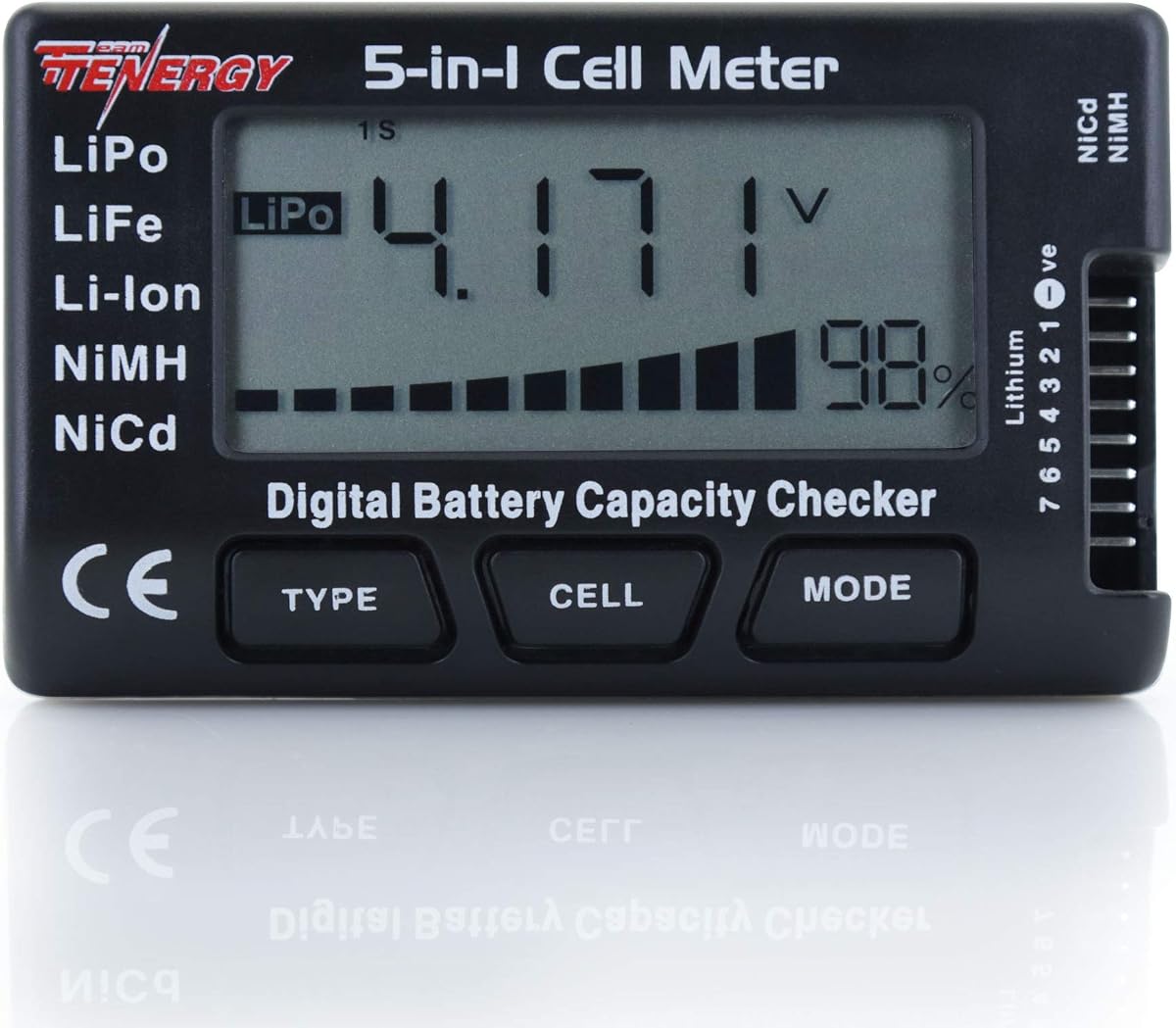
The Tenergy 5-in-1 Battery Meter is praised for its ability to balance and discharge battery packs. It operates without external power by drawing energy from the battery being tested. This feature makes it highly portable and convenient for field use.
We may earn a commission when you buy through this link, at no additional cost to you.
Users can set discharge thresholds to prepare batteries for storage safely. The device helps optimize performance by ensuring individual cells are balanced. Internal resistance testing adds another layer of insight into pack health and longevity.
A limitation is that it requires a connected battery to power on, meaning it cannot check single loose cells. The discharge rate of 180mA is slow for large packs but sufficient for maintenance. These trade-offs are acceptable for its primary use case.
This tool is ideal for RC hobbyists who need to maintain battery packs regularly. It extends the lifespan of expensive batteries by keeping cells balanced. We recommend it for those looking to simplify their battery maintenance routine.
Drawing power from the battery under test eliminates the need for an external power source.
Balancing cells ensures consistent voltage levels, which maximizes the runtime of your battery packs.
We may earn a commission when you buy through this link, at no additional cost to you.
The FLY RC Cellmeter 7 holds a 4.6 rating for delivering high-quality performance at a low cost. It is designed for durability and compactness, making it easy to carry to the field. Users can check cell voltages and remaining battery capacity instantly.
We may earn a commission when you buy through this link, at no additional cost to you.
Key strengths include the display of total voltage and the gap between highest and lowest cells. This helps identify weak cells that need attention or replacement. The device supports NiCd, NiMH, and Lithium types up to seven cells.
While it lacks advanced balancing features, it fulfills its role as a voltage checker effectively. The remaining capacity percentage adds useful context for flight or operation times. These trade-offs are acceptable given the very competitive price point.
This unit is perfect for beginners or hobbyists needing a basic, reliable tool. It ensures safety by preventing the use of depleted batteries. We recommend it as an excellent entry-level option for RC battery monitoring.
Showing the voltage gap between cells helps quickly identify imbalance without complex analysis.
The lightweight design ensures it adds minimal weight to your hobby gear kit.
We may earn a commission when you buy through this link, at no additional cost to you.
The ISDT BG-8S Lipo Battery Checker is a premium tool that integrates advanced monitoring features. With a 4.4 rating, it offers detailed parameter readings when paired with the XT60i connector. This includes battery cycles and specific working parameters for deeper insight.
We may earn a commission when you buy through this link, at no additional cost to you.
It features an auto balancing algorithm that ensures every cell is balanced properly. The device also acts as a power bank, supporting Qualcomm QC 2.0 and 3.0 for charging phones. This dual functionality adds significant value beyond simple testing.
Users should note that full BattGO features require the specific XT60i accessory. The price is higher than standard testers, but the power bank function justifies the cost for many. The auto balancing ensures your packs remain healthy over time.
This checker is ideal for professionals or serious hobbyists who demand detailed battery data. It saves weight by replacing the need for a separate power bank. We recommend it for those seeking an all-in-one solution for RC power management.
Connecting with XT60i unlocks detailed cycle data and parameter history for better maintenance planning.
Using the checker to charge your phone makes it a versatile tool for field days.
We may earn a commission when you buy through this link, at no additional cost to you.
The ISDT BG-8S Battery Meter is recognized for its extensive capabilities in RC battery management. It earns a 4.7 rating for balancing performance and usability. The device supports multiple protocol analyses including PWM and PPM for receiver signal testing.
We may earn a commission when you buy through this link, at no additional cost to you.
The auto balancing feature ensures individual cells are optimized for performance and longevity. It also serves as a high-power portable charger with up to 12V and 2A output. This makes it a versatile tool for maintaining both batteries and personal devices.
Users need to understand the specific connector requirements to utilize all features effectively. The receiver signal testing is a unique benefit not found on many other meters. While it is feature-rich, the complexity might be high for casual users.
This unit is best for advanced RC users who need diagnostics beyond simple voltage checks. It consolidates multiple tools into one compact device. We recommend it for professionals seeking a reliable and multifunctional power management solution.
Testing receiver signals helps ensure your RC equipment is functioning correctly before flight.
Advanced algorithms automatically match cell voltages to extend overall pack lifespan.
We may earn a commission when you buy through this link, at no additional cost to you.
The Advanced 8 Channel Battery Tester is designed for professionals needing high-volume testing capabilities. It features eight independent channels that allow for simultaneous or individual operations without interference. This design is ideal for workshops and laboratories testing 18650 batteries.
We may earn a commission when you buy through this link, at no additional cost to you.
A 2.4 inch color screen provides clear real-time data on charge and discharge cycles. The active heat dissipation system ensures stable performance during long testing sessions. Reverse connection protection adds a layer of safety for users handling multiple batteries.
While it lacks a user rating due to its newer market presence, the specifications suggest high reliability. The capacity measurement is accurate enough for professional quality control. These features make it a robust choice for serious battery management.
This tester is recommended for electronics enthusiasts and professionals working with lithium batteries. It simplifies the workflow for large batches of cells needing evaluation. We suggest it for those requiring detailed analysis and high throughput.
Eight independent channels allow for testing multiple batteries simultaneously without data interference.
The active heat dissipation system maintains accuracy during extended testing periods.
We may earn a commission when you buy through this link, at no additional cost to you.
The QWORK RC Battery Capacity Checker earns a 4.7 rating for its straightforward and effective design. It works with LiPo and NiMH packs from 2S to 7S, offering instant voltage readings. The digital screen displays total and per-cell voltages clearly for quick checks.
We may earn a commission when you buy through this link, at no additional cost to you.
Key strengths include the display of maximum and minimum cell voltages to spot imbalance. The compact design makes it easy to carry in a field bag for on-site diagnostics. It supports multiple chemistries to fit various RC applications.
It is strictly for testing and does not offer charging capabilities. Additionally, it requires balance connectors, so single cells cannot be tested. These limitations are acceptable for its primary purpose of quick field checking.
This checker is perfect for drone pilots and RC car drivers needing fast battery insights. It helps prevent crashes by verifying pack health before takeoff. We recommend it for anyone prioritizing portability and simplicity.
The digital screen provides immediate voltage data so you can make quick decisions.
The lightweight design ensures the checker fits easily into any RC tool kit.
We may earn a commission when you buy through this link, at no additional cost to you.
The ZTS Mini Multi-Battery Load Tester is highly rated for its patented Pulse Load Technology. It measures battery charge under load, which is more reliable than simple voltage readings. A fully automatic 2-second test identifies weak or failing batteries instantly.
We may earn a commission when you buy through this link, at no additional cost to you.
It supports common sizes like AA, AAA, C, D, and 9V along with various chemistries. The compact design allows leads to be stored neatly within the seam for portability. Being made in the USA adds to its appeal for those seeking quality manufacturing.
Users should note it does not show exact voltage numbers but indicates status. This makes it simpler for quick checks but less detailed than digital meters. However, its ability to save money by preventing waste is a significant benefit.
This tester is ideal for households with many disposable and rechargeable batteries. It ensures you recycle only what is truly dead. We recommend it for general home use where simplicity and accuracy are key.
Pulse Load Technology measures performance under load for accurate results.
No settings or switches are required making it easy to use immediately.
We may earn a commission when you buy through this link, at no additional cost to you.
Selecting the right Li Ion Battery Tester depends on your specific needs and technical requirements. This guide breaks down the key factors to consider for an informed purchase.
Ensure the device supports the battery types and sizes you use most often. Some models are specific to 18650 cells while others handle household AA or C batteries. Check connectors like balance leads or standard terminals for a match.
Always verify the supported voltage range and chemistry types before buying.
High-quality testers provide accurate capacity and internal resistance readings. Look for devices that measure under load for more reliable results than open circuit voltage. Precision matters if you use batteries for critical electronics or RC vehicles.
Prioritize models with certified accuracy metrics if professional use is required.
A clear LCD or OLED screen helps you read data easily in various lighting conditions. User-friendly interfaces with minimal buttons simplify the testing process. Ensure the screen shows essential metrics like voltage and internal resistance clearly.
Choose a display format that is intuitive for your specific skill level.
Consider how the tester itself is powered. Some units are rechargeable via USB-C while others use disposable batteries. A built-in battery allows for portable use without needing an external power supply.
Rechargeable options offer better long-term value for frequent users.
For fieldwork or hobbyist use, compact and lightweight designs are essential. A small form factor ensures the device fits in your gear bag easily. Check if leads and accessories can be stored securely within the device.
Select a rugged build if you plan to use it outdoors often.
Some testers offer extra functions like balancing or charging capabilities. Look for safety features like reverse connection protection to prevent damage. Extra features can justify a higher price if they save time or money.
Evaluate whether these add-ons align with your testing goals.
Build quality affects the lifespan of the device. Look for reviews mentioning sturdy construction and reliable performance over time. A durable unit protects your investment against drops and daily wear.
Prioritize models with positive feedback on long-term reliability.
A solid warranty indicates manufacturer confidence in the product. Check the duration of coverage and availability of customer support. Good support helps resolve issues if the device malfunctions unexpectedly.
Always review warranty terms before finalizing your purchase.
Read the user manual carefully before connecting any battery. Ensure the tester is set to the correct battery type to avoid incorrect readings or damage. Most devices require specific connections for balance packs or standard terminals.
Clean the probes regularly with a soft dry cloth to remove corrosion or dirt. Keep the device in a dry place to prevent moisture damage to internal circuits. Avoid exposing the tester to extreme temperatures during storage or use.
For rechargeable models, follow charging guidelines to preserve the internal battery. Calibrate the device if recommended by the manufacturer for consistent accuracy. Regular maintenance ensures your tester provides reliable results for years.
Voltage testing measures the potential electrical pressure in a battery while capacity measures total energy stored. Capacity tests often discharge the battery to gauge how much power it actually holds. Both are important for assessing overall battery health and longevity.
Li Ion batteries can degrade over time and may pose safety risks if damaged. A tester helps identify cells with low capacity or high internal resistance before they fail. This prevents damage to devices and reduces the risk of overheating.
Some universal testers cover AA to 9V and Li Ion, but specialty models exist for specific uses. Check the device specifications to ensure compatibility with your batteries. Most household testers do not support RC LiPo packs without specific connectors.
Test batteries regularly during storage to catch issues early. For active use, check before critical flights or devices to ensure performance. Monthly checks are generally sufficient for most household or hobby applications.
Internal resistance shows how easily current flows within the battery cells. High resistance often signals aging or damage which reduces performance under load. Monitoring resistance helps predict when a battery needs replacement.
Yes if you use a device designed for safety with proper protections. Ensure the tester has reverse polarity protection and voltage limits. Follow manufacturer instructions to avoid short circuits or overheating.
This guide reviewed ten top models ranging from budget-friendly to advanced professional tools. Options like the ISDT BG-8S offer comprehensive features while basic models provide reliable voltage checks. Selecting the right one depends on your specific testing needs and budget.
Prioritize compatibility and accuracy when making your choice to ensure reliable results. Features like balancing and multi-channel support add value for serious hobbyists. General users may prefer simpler universal testers for household maintenance.
Remember that prices and availability can change quickly so check current offers before buying. Always verify the latest specifications to match your requirements. Investing in a quality tester ensures your batteries remain safe and efficient.