
QNAP TL-D1600S
4.5Editor score
16 Bay SATA 6Gbps
PCIe Interface Card Included
Compatible with Windows Linux
Finding the right storage solution for massive data needs requires careful consideration of drive bays, connectivity, and cooling. A robust 16 Bay NAS Enclosure offers the scalability and performance needed for businesses, media creators, and advanced home users managing terabytes of information daily.
We evaluated ten leading models based on their hardware specifications, expansion capabilities, thermal management, and overall reliability. Our analysis focuses on how well each enclosure handles high-density drive configurations while maintaining data integrity and ease of use for IT professionals and enthusiasts.
Each selection below highlights specific strengths such as hot-swap support, rackmount design, or hybrid NAS integration. Note that availability and configurations may vary over time, so verifying current specs with the manufacturer is recommended before making a final purchasing decision.
4.5Editor score

As an Amazon Associate we earn from qualifying purchases.
The following table provides a side-by-side look at the key specifications and features of the top 16 Bay NAS Enclosures available this month, helping you quickly identify the model that fits your specific storage and performance requirements.


The CENMATE Aluminum 12 Bay Hard Drive Enclosure offers a practical solution for users needing quick access to multiple drives. With a 4.3 rating, it stands out for its robust aluminum construction and effective cooling system.
We may earn a commission when you buy through this link, at no additional cost to you.
Its USB 3.0 interface ensures transfer speeds of up to 5Gbps, making it suitable for transferring large files quickly. The tool-free design allows for rapid drive changes, which is essential for backup or archival tasks.
While the cooling fans are necessary for thermal management, their noise level might be a consideration for quiet environments. Additionally, this model supports up to 12 drives rather than 16, which may limit future scaling.
This enclosure is ideal for home users or small offices needing reliable external storage without complex RAID setup. Its plug-and-play compatibility ensures easy integration with existing systems.
USB 3.0 ports enable rapid data movement, reducing wait times for backups and media transfers.
Integrated aluminum alloy body and fans help maintain safe operating temperatures for long-term use.
We may earn a commission when you buy through this link, at no additional cost to you.
The Synology 16 bay RackStation RS4021xs+ is a powerhouse designed for enterprise-level storage needs. Its powerful 8-core Intel processor handles multiple compute-intensive services efficiently.
We may earn a commission when you buy through this link, at no additional cost to you.
Business continuity is ensured through redundant power supplies, minimizing downtime risks during power fluctuations. The ability to expand up to 40 bays using expansion units provides significant scalability for growing data demands.
While it comes diskless, the flexibility to configure drives later allows for customization based on specific capacity requirements. The 5-year warranty adds peace of mind for critical business applications.
This model is best suited for organizations requiring reliable, scalable, and high-performance storage. Its integration with Synology ecosystem tools simplifies management and administration.
Expansion slots allow adding M.2 NVMe cache and network cards for tailored high-speed connectivity.
Redundant power and strong processor support ensure continuous uptime for mission-critical services.
We may earn a commission when you buy through this link, at no additional cost to you.
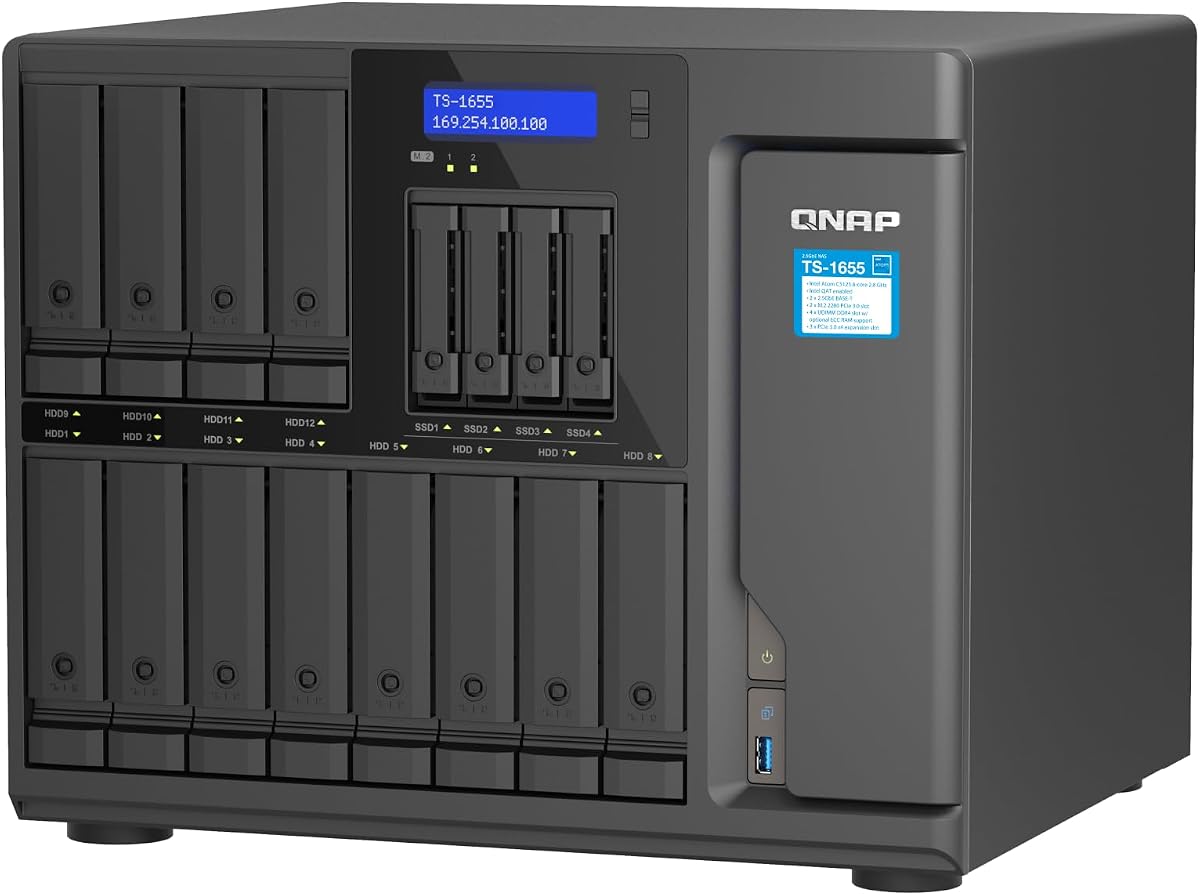
The QNAP TS-1655-8G-US brings hybrid NAS capabilities to the forefront, offering a balanced approach to storage and computing. It supports a mix of 3.5 and 2.5-inch drives for flexible configuration.
We may earn a commission when you buy through this link, at no additional cost to you.
With dual 2.5GbE ports, this unit accelerates intensive file access and multimedia transfer tasks. The inclusion of M.2 NVMe PCIe slots allows for SSD caching or storage pool implementations.
The Intel Atom processor provides efficient power usage while handling virtualization workloads. Memory support up to 128GB with ECC ensures data integrity for critical operations.
Ideal for tech-savvy users wanting advanced NAS features without full server complexity. It bridges the gap between storage and compute needs effectively.
M.2 NVMe slots enable SSD caching, significantly speeding up frequent data access and application responses.
Strong CPU and memory support allow running virtual machines directly on the NAS for integrated workflows.
We may earn a commission when you buy through this link, at no additional cost to you.
The Synology 12 Bay Disk Expansion DX1222 is a specialized unit designed to extend storage capacity for compatible Synology diskstation units. It simplifies the expansion process through unified DSM tools.
We may earn a commission when you buy through this link, at no additional cost to you.
Its compatibility ensures that new storage is configured quickly, making it easy for administrators to scale up without downtime. The 5-year warranty reflects confidence in its durability and performance.
As an expansion unit, it lacks standalone functionality but excels in its specific role. Users looking to add capacity to existing Synology systems will find this the most convenient option.
Recommended for Synology ecosystem users needing straightforward, reliable storage growth. It ensures consistency and ease of use within the Synology environment.
Designed specifically for Synology units, allowing quick integration and management via DSM software.
5-year warranty provides assurance of quality and support for long-term storage deployments.
We may earn a commission when you buy through this link, at no additional cost to you.
The Generic ZhenLoong Full Tower NAS Computer case offers a blank canvas for building a custom storage server. It supports various motherboard formats from ITX to EATX and includes hot swap bays for 15 drives.
We may earn a commission when you buy through this link, at no additional cost to you.
With eight full-height expansion slots, users can add network cards, GPU accelerators, or other specialized hardware. This flexibility is unmatched for enthusiasts who need specific hardware configurations.
Be aware that shipping cycles can extend up to 40 days via sea, which may delay projects. The chassis requires assembly with compatible components, adding complexity compared to pre-built solutions.
This case is perfect for IT professionals or hobbyists wanting a tailored workstation or server. It supports intensive tasks like GPU acceleration alongside massive storage.
Multiple motherboard and expansion slot support allows building a system that meets exact hardware needs.
Supports up to 15 hot swap drives, offering substantial internal storage for large-scale applications.
We may earn a commission when you buy through this link, at no additional cost to you.
The Asustor Lockerstor 10 Gen3 focuses on high-speed performance for media and enterprise workflows. It features an AMD Ryzen processor and 16GB ECC DDR5 RAM to ensure data integrity.
We may earn a commission when you buy through this link, at no additional cost to you.
Dual 10GbE and dual 5GbE ports offer ultra-high bandwidth for multi-user environments. The inclusion of USB4 40Gbps provides additional fast external connectivity options.
Four M.2 NVMe slots support SSD caching or storage pools, improving response times for databases or editing. Despite its 10-bay limitation, it delivers strong performance for demanding tasks.
Recommended for users needing fast network throughput and robust memory. It is a powerful choice for studios or offices handling large media files.
Multiple high-speed Ethernet ports enable rapid data transfer across networks for heavy traffic environments.
Built to handle 4K/8K media workflows, ensuring smooth editing and streaming with high-performance specs.
We may earn a commission when you buy through this link, at no additional cost to you.
The Synology 12 Bay DiskStation DS3622xs+ delivers top-tier performance for virtualization and backup systems. Its Intel Xeon processor supports over 260,000 4K random read IOPS for fast access.
We may earn a commission when you buy through this link, at no additional cost to you.
Networking capabilities include 10/25GbE options and Fibre Channel support, catering to diverse infrastructure needs. You can scale up to 36 bays using expansion units, providing immense capacity.
Up to 48GB memory allows running multiple virtual machines efficiently. While the investment is significant, the performance and scalability justify it for enterprise use.
Ideal for businesses needing reliable virtualization and backup services. Its Synology platform ensures ease of management and broad compatibility.
High core count and memory support enable efficient running of multiple virtual servers and containers.
Multiple high-speed network interfaces allow seamless integration into complex and fast corporate networks.
We may earn a commission when you buy through this link, at no additional cost to you.
The QNAP TL-R1600PES-RP-US is a 16-bay 3U rackmount JBOD designed to expand QNAP NAS storage efficiently. Its short depth design fits easily into smaller media cabinets or crowded racks.
We may earn a commission when you buy through this link, at no additional cost to you.
Mini-SAS HD ports provide high-bandwidth connectivity for reliable data transfer. Redundant power supplies ensure service continuity even if one power source fails.
Economically expanding storage to petabyte levels is feasible with this unit. It is best used as an expansion unit rather than a standalone server.
Suitable for server rooms needing organized, reliable, and scalable storage. The short depth saves valuable rack space for other equipment.
3U short depth saves space in racks, allowing room for additional networking or compute equipment.
Dual power supplies guarantee uptime and prevent data loss during power disruptions in server environments.
We may earn a commission when you buy through this link, at no additional cost to you.
The QNAP TL-D1600S is a high-performance desktop JBOD storage enclosure that includes a PCIe SATA interface card. It supports up to 16 bays combining 3.5 and 2.5-inch drives.
We may earn a commission when you buy through this link, at no additional cost to you.
Designed for Windows and Linux computers, it offers flexible storage expansion for workstations. The SATA 6Gbps interface ensures fast data access for professional applications.
While it does not include RAID capabilities, its simplicity and speed make it suitable for large non-redundant storage pools. Users need an available PCIe slot for installation.
Ideal for creators or IT professionals needing quick desktop expansion. It balances ease of use with high-speed performance effectively.
Includes necessary PCIe card for immediate setup, simplifying installation for desktop users.
Supports mixed drive sizes, allowing optimized use of both large capacity and smaller SSD drives.
We may earn a commission when you buy through this link, at no additional cost to you.
The QNAP TS-1655-8G-US stands out for its commitment to long-term availability, making it reliable for ongoing deployments. It combines high performance with high capacity in a hybrid NAS design.
We may earn a commission when you buy through this link, at no additional cost to you.
Dual 2.5GbE ports accelerate intensive file access and virtualization tasks. The 8-core processor handles large backup/restoration tasks efficiently without lag.
With ECC support and memory upgradable to 128GB, it ensures data integrity and smooth operation. M.2 NVMe slots allow for caching and faster image recognition tasks.
Recommended for businesses planning long-term infrastructure. Its consistency and performance make it a solid investment for hybrid storage workflows.
Long-term availability ensures consistent access to hardware for maintenance and future system expansions.
Powerful processor and memory options support complex multitasking and intensive data processing needs.
We may earn a commission when you buy through this link, at no additional cost to you.
Selecting the right 16 Bay NAS Enclosure involves assessing several critical factors that affect performance, reliability, and ease of use.
Ensure the enclosure supports the size and number of drives you plan to use. Some models support a mix of 3.5 and 2.5-inch drives for flexible storage arrangements.
Prioritize models with tool-free hot-swap capabilities to simplify maintenance and drive replacements without downtime.
Look for high-speed interfaces like USB 3.0, PCIe, or Mini-SAS HD to avoid bottlenecks during large data transfers. Faster connections improve backup and retrieval times significantly.
Select units with robust network options if you need to share storage across multiple users or devices efficiently.
High-density enclosures generate significant heat, so efficient cooling systems with fans or airflow channels are essential. Check fan noise levels if the device will be used in quiet environments.
Metal bodies often provide better heat dissipation compared to plastic alternatives, contributing to long-term hardware lifespan.
Choose models that allow daisy chaining or connection to additional units if your storage needs are likely to grow. This avoids the cost and effort of replacing the entire system later.
Verify that the enclosure supports the specific expansion cards or protocols required by your existing network or server setup.
Confirm that the enclosure works seamlessly with your operating system such as Windows, Linux, or macOS. Plug-and-play support reduces configuration headaches.
For enterprise setups, ensure the device integrates well with existing NAS software or management tools you already use.
Redundant power supplies are critical for business applications to prevent data loss during unexpected outages. They add cost but significantly improve uptime.
Check the power adapter rating to ensure it can handle peak loads when multiple drives spin up simultaneously.
A longer warranty period reflects confidence in the product's build quality and durability. Look for at least a 5-year warranty for critical storage solutions.
Consider the availability of technical support and firmware updates to keep the device secure and functional over time.
Begin by installing drives one by one and verifying functionality before adding the next to avoid confusion. This ensures each drive is recognized correctly by the system.
Regularly check and clean cooling vents to maintain optimal temperatures and prevent dust buildup that can affect performance.
Keep firmware updated to benefit from security patches and performance improvements released by the manufacturer.
A NAS enclosure typically includes integrated processing and operating system features for network sharing and management. A JBOD enclosure provides raw storage expansion without independent networking capabilities.
Yes, most modern enclosures support both SSDs and HDDs as long as the interface matches. Always check manufacturer specifications for compatibility details.
Use the tool-free hot swap bays carefully by ensuring the system recognizes the drive before removal. Avoid forcing drives to prevent connector damage.
Some units like QNAP hybrid NAS support software RAID. However, standalone DAS enclosures often require external controller cards or software for RAID.
Use the included power supply or one with sufficient wattage to handle all drives spinning up simultaneously. Redundant supplies are recommended for critical environments.
Noise levels vary but typically range from 40 to 60 decibels. Look for models with adjustable fan curves or low-decibel ratings for quiet spaces.
Choosing the right 16 Bay NAS Enclosure depends on your specific needs for speed, scalability, and integration. Options like QNAP hybrid NAS offer advanced features for power users.
Prioritize thermal management and expandability to ensure your storage solution lasts. Reliable power and cooling are key to maintaining data integrity over time.
Always verify current product specs and compatibility before purchasing to match your current infrastructure. Prices and models may change as new technology emerges.