
Arduino UNO R3 Board
4.0Editor score
ATmega328P 16MHz Microcontroller
14 Digital and 6 Analog I/O Pins
Full Compatibility with Arduino IDE
This guide compares the top Arduino Uno Q boards and kits for AI robotics and IoT projects helping you choose the best hybrid development platform for your
The Arduino Uno Q represents a significant leap forward in embedded development by combining high-performance computing with real-time control capabilities. This hybrid board offers developers the power to run complex AI models while maintaining the simplicity and reliability of the Arduino ecosystem for sensor integration and motor control.
We evaluated ten top products including official boards starter kits and compatible alternatives to help you find the right solution. Our comparison focuses on processing power memory storage connectivity options and overall value for engineers students and hobbyists building advanced robotics or IoT systems today.
Each pick highlights key strengths and ideal use cases so you can make an informed decision for your next project. Please note that prices and availability change frequently so check the current listings before purchasing to ensure you get the best deal available at this time.
4.0Editor score

4.4Editor score
3.7Editor score
The following table provides a side-by-side comparison of all ten products featured in this guide allowing you to quickly assess their specifications and suitability for your specific project requirements and budget constraints.


The Arduino® UNO™ Q 4GB stands out as the premier hybrid development platform combining the power of a single-board computer with the simplicity of Arduino. With a rating of 4.4 stars it is favored by developers who need to run complex AI models alongside real-time sensor control. Its standout qualities include the Qualcomm Dragonwing processor and full Linux Debian support which unlocks possibilities far beyond traditional microcontrollers.
We may earn a commission when you buy through this link, at no additional cost to you.
At its core this board features a Qualcomm Dragonwing QRB2210 MPU with a Quad-core Arm Cortex-A53 CPU running at 2.0 GHz paired with an STM32U585 MCU for real-time tasks. The inclusion of 4 GB LPDDR4 RAM and 32 GB eMMC storage allows for robust multitasking and local AI model execution without needing cloud connectivity. You can run Python scripts containerized AI models and traditional Arduino Sketches all within the same environment using Arduino App Lab.
While the board offers immense power there are trade-offs to consider. The price point is significantly higher than standard Arduino boards which may be a barrier for budget-conscious beginners. Additionally migrating from pure microcontroller workflows to a Linux-based environment requires some learning regarding package management and system configuration though Arduino App Lab simplifies much of this process.
This platform is ideal for engineers and advanced hobbyists building robotics IoT or smart vision systems that require edge computing capabilities. If you need to process voice commands run object recognition or manage complex IoT networks while still controlling motors and sensors directly the UNO Q is the best choice. We recommend it for anyone ready to bridge the gap between embedded systems and high-performance computing.
The Adreno GPU and AI acceleration hardware enable real-time object recognition and vision tasks that are impossible on standard microcontrollers without external modules.
Arduino App Lab provides a single interface to mix Python scripts and Arduino Sketches allowing seamless transitions between high-level logic and low-level hardware control.
We may earn a commission when you buy through this link, at no additional cost to you.
This kit bundles the powerful Arduino UNO Q 4GB AI Board with a dedicated 45W USB-C power supply ensuring you have the stable energy required for demanding applications. It is designed for engineers who need reliable operation during heavy computing tasks or when multiple peripherals are connected. The focus on power integrity makes it a premium choice for professional and industrial development environments where downtime is not an option.
We may earn a commission when you buy through this link, at no additional cost to you.
The board itself features the same high-performance Qualcomm and STM32 hybrid architecture allowing for advanced AI models and multitasking capabilities. The included 45W USB-C power supply is a critical addition that ensures stable and regulated power delivery even under heavy workloads or when powering external sensors and displays directly from the board. This prevents brownouts or resets that can occur with weaker power sources.
However the value proposition is primarily in the power bundle rather than additional expansion modules or accessories. You will still need to source your own sensors displays or cases separately which adds to the overall project cost. For users who already have these peripherals the standalone board might suffice but for those starting fresh the convenience of included reliable power is valuable.
We recommend this pack for developers building scalable AI robotics or industrial IoT systems where power stability is paramount. If your project involves continuous operation with high computational loads or numerous connected devices this kit provides the foundation needed for reliability. It is a smart investment for professionals who prioritize system stability over initial cost savings.
The 45W USB-C power supply prevents voltage drops during high CPU usage ensuring your robotics or IoT system remains stable during intensive processing tasks.
Designed for engineers building scalable systems this kit supports the robust wireless communication and processing power needed for smart device ecosystems.
We may earn a commission when you buy through this link, at no additional cost to you.
The GeeekPi Starter Kit transforms the Arduino UNO Q into a fully functional standalone single-board computer by including every essential accessory you need. Rated 4.6 stars by users it is perfect for those who want to use the board with a monitor and keyboard immediately. The inclusion of an aluminum case HDMI cable and USB-C hub makes it the most ready-to-use option for desktop computing and embedded development alike.
We may earn a commission when you buy through this link, at no additional cost to you.
This kit includes the official UNO Q with 2 GB of RAM and 16 GB of eMMC storage which is sufficient for most development tasks and basic AI projects. The rugged aluminum case protects the board from dust and static electricity while ensuring efficient heat dissipation during long operating sessions. The USB-C hub with Ethernet significantly expands connectivity options making it easier to integrate into professional networked environments.
While the 2GB RAM and 16GB storage are adequate for many use cases they are lower than the 4GB version available separately. If you plan to run heavy machine learning models or store extensive logs locally you might hit limits sooner. However for learning Linux using Python or prototyping robotics this configuration offers a balanced performance profile at a competitive price point.
This kit is highly recommended for educators makers and developers who want a plug-and-play solution for learning Linux on embedded hardware. It removes the friction of sourcing individual cables and cases so you can focus on coding and building. We suggest it for anyone looking to use the UNO Q as a primary development computer without needing additional hardware purchases.
Includes HDMI Ethernet power and hub accessories so you can connect to a monitor and network immediately without buying extra peripherals.
The sturdy aluminum housing protects your investment from physical damage and heat ensuring your board survives the rigors of prototyping and transport.
We may earn a commission when you buy through this link, at no additional cost to you.
The Arduino Uno REV3 remains the gold standard for entry-level electronics and prototyping with its simple design and massive community support. With a 4.8 rating it is trusted by millions of users worldwide for reliability and ease of use. While it lacks the advanced AI capabilities of the Q series its straightforward architecture makes it perfect for learning basics and building standard control systems.
We may earn a commission when you buy through this link, at no additional cost to you.
Powered by the ATmega328P microcontroller running at 16 MHz it provides 14 digital I/O pins and 6 analog inputs for connecting sensors and actuators. The 32KB of flash memory is sufficient for most standard sketches and the USB connectivity allows for easy programming through the Arduino IDE. Its compatibility with the vast ecosystem of shields and libraries means you can extend its functionality without deep hardware knowledge.
The main trade-off is the lack of integrated wireless connectivity or advanced processing power. You will need external modules to add Wi-Fi or Bluetooth and it cannot run Linux or complex AI models. However this simplicity is often a benefit for beginners who want to focus on coding logic rather than system configuration or troubleshooting complex OS issues.
This board is ideal for students hobbyists and anyone starting their electronics journey who needs a dependable platform. It is excellent for learning robotics home automation or basic IoT projects where you can add wireless modules later if needed. We recommend it as the first board for anyone new to programming microcontrollers.
Standard in educational environments this board is perfect for learning electronics and programming with simple clear documentation and community examples.
Six analog inputs and PWM capable digital pins provide flexible options for sensors motors and other external components without additional hardware.
We may earn a commission when you buy through this link, at no additional cost to you.
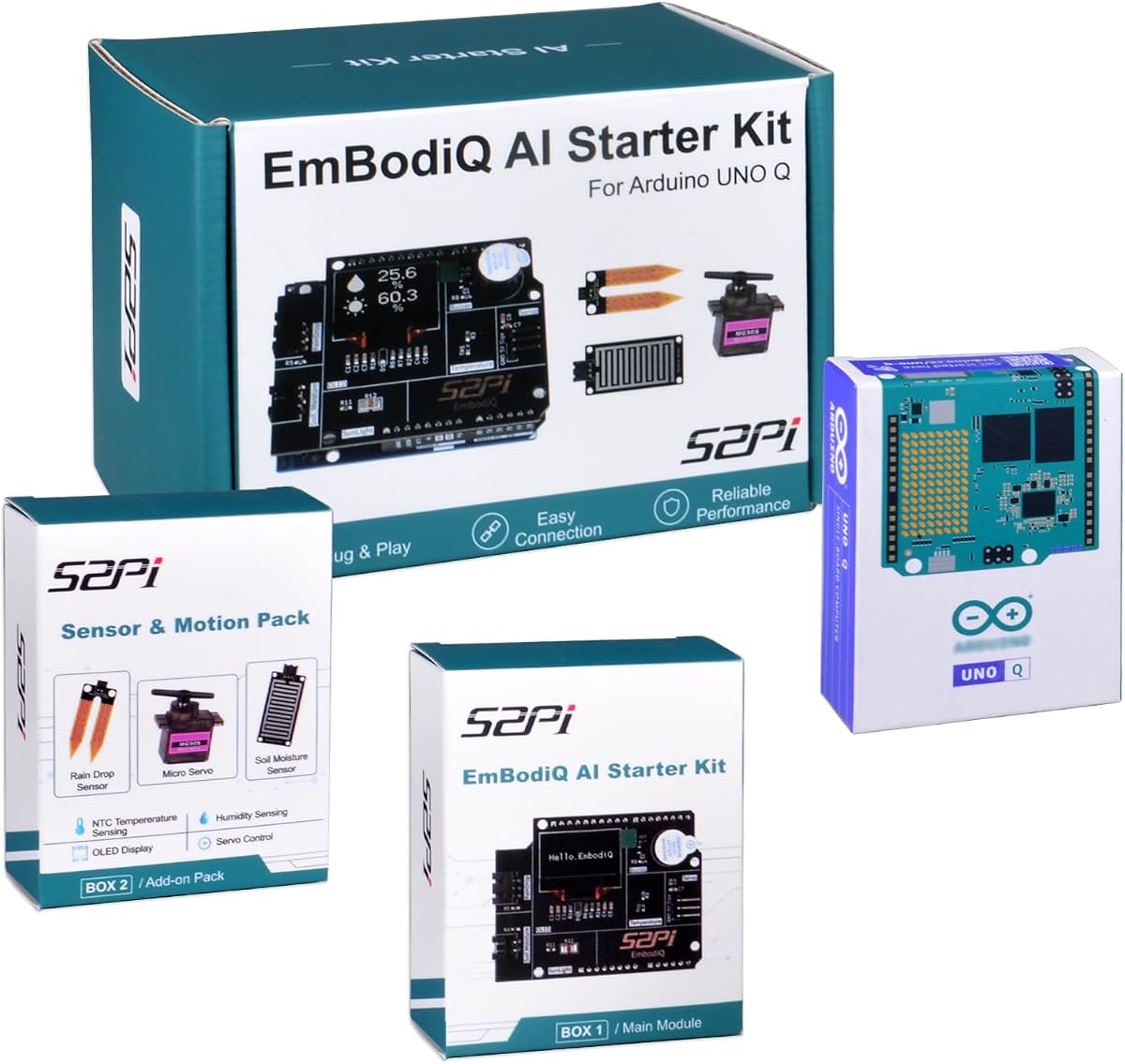
This innovative kit lets you control hardware using natural language commands making it accessible to non-technical users or those who prefer conversational interfaces. With a 3.7 rating it shows potential for unique use cases in gardening weather monitoring or simple home automation. The core strength is the EmbodiQ AI Agent HAT which enables real-time reasoning and multi-step task execution without writing complex logic manually.
We may earn a commission when you buy through this link, at no additional cost to you.
The kit includes the UNO Q with 4GB RAM and 32GB eMMC storage providing enough power to run the AI Agent locally. You can connect sensors like soil moisture or raindrop detectors and control servos or OLED displays simply by telling the AI what you want to do. It supports multiple AI providers including OpenAI and OpenRouter giving you flexibility in how you manage intelligence in your projects.
However the reliance on AI models means performance can depend on internet connectivity or model availability. Some users report a learning curve to get the natural language responses to be consistently accurate. The sensor suite is limited to specific examples so you may need to buy extra components for broader projects beyond the intended use cases.
This kit is best for educators and hobbyists interested in exploring the future of human-computer interaction with hardware. If you want to build a smart garden or weather station where you can ask questions or give commands instead of coding conditions this is a unique choice. We recommend it for experimental projects rather than mission-critical systems.
Talk to your hardware to control sensors and outputs without complex coding enabling more intuitive and accessible smart projects for all users.
Python and Arduino co-processing ensures responsive performance even when running complex AI reasoning tasks alongside real-time hardware control.
We may earn a commission when you buy through this link, at no additional cost to you.
The Arduino UNO R4 WiFi bridges the gap between simple microcontrollers and powerful IoT devices by offering integrated wireless connectivity and unique features like an LED matrix. With a 4.7 rating it is a favorite for connected projects that don't require heavy AI processing. Its dual-core processing ensures flexibility for tasks ranging from high-speed communications to edge AI applications using the ESP32-S3 chip.
We may earn a commission when you buy through this link, at no additional cost to you.
Key features include the 12-bit DAC and OP-AMP for precise analog signal generation useful for audio or sensor interfacing projects. The built-in 12×8 LED Matrix allows for immediate visual feedback without needing external displays which simplifies prototyping significantly. USB-C connectivity and CAN bus support make it modern and versatile for both hobby and industrial uses.
While it offers significant improvements over the R3 it does not support Linux or run complex AI models natively like the Q series. The RAM is also more limited meaning you cannot store large datasets or run containerized applications. If your project requires Python scripts or heavy machine learning this board will need external help or a different platform choice.
This board is ideal for IoT sensors remote control systems and interactive displays where wireless connectivity is key. It is perfect for projects requiring immediate visual feedback or precise analog control without external modules. We recommend it for makers who need wireless capabilities but want to stay within the classic Arduino ecosystem simplicity.
Wi-Fi and Bluetooth 5.0 ensure robust communication for smart devices and remote sensors without requiring extra shields or modules.
The built-in LED Matrix allows users to display dynamic visuals and real-time data directly on the board for interactive interfaces.
We may earn a commission when you buy through this link, at no additional cost to you.
This comprehensive kit offers an excellent introduction to electronics and programming with guided lessons that take you from blinking LEDs to controlling motors. Rated 4.7 stars it is designed for families or classrooms needing a structured learning path. The variety of included components ensures you can build multiple distinct projects without buying additional parts immediately.
We may earn a commission when you buy through this link, at no additional cost to you.
You receive the UNO R3 controller along with an LCD display ultrasonic sensor DHT11 temperature sensor servo and stepper motors. The kit includes a solderless breadboard and pre-soldered modules so you can focus on wiring and code rather than assembly. The included PDF tutorial provides step-by-step instructions and code examples for each of the 22+ lessons to ensure smooth progression.
The main limitation is that it uses the standard R3 board which lacks modern features like built-in Wi-Fi or the advanced processing of the Q series. However for learning the fundamentals of electronics and programming logic this is not a significant drawback. The kit focuses on teaching core concepts rather than cutting-edge capabilities.
This kit is highly recommended for beginners students or anyone teaching electronics at home or in a classroom. It provides everything needed to start building and understanding how code interacts with hardware immediately. We suggest it as the ideal starting point for anyone wanting a structured and comprehensive entry into the world of Arduino.
Follow 22+ guided lessons to make LEDs blink read temperature and control motors making it ideal for homeschool or STEM units.
Plug-in modules and a breadboard help beginners focus on wiring and code without needing soldering skills or specialized tools.
We may earn a commission when you buy through this link, at no additional cost to you.
The ELEGOO UNO R3 board is the perfect choice for those who already have components and just need a reliable controller to start coding. Rated 4.7 stars it offers great value by including a USB cable essential for programming without extra cost. It is a clone of the official board but maintains full compatibility with the Arduino IDE and existing libraries.
We may earn a commission when you buy through this link, at no additional cost to you.
Powered by the ATmega328P at 16 MHz it provides 14 digital I/O pins and 6 analog inputs for everyday projects like LEDs and sensors. The ATmega16U2 USB interface supports reliable sketch uploads and serial communication making it easy to connect to your computer. You can expand your way with shields and modules as your skills grow.
The board does not come with sensors or motors so you will need to source those separately. This makes it less convenient than a starter kit if you are brand new but more cost-effective if you just need a replacement controller. The build quality is solid and fits standard breadboards perfectly for easy prototyping.
We recommend this board for hobbyists on a budget or anyone who needs a spare board for multiple projects. It is also ideal for classrooms needing multiple controllers without the expense of full kits for each student. If your priority is cost and compatibility this board delivers exactly what you need.
The ATmega16U2 USB interface supports sketch uploads and serial communication while clearly labeled headers simplify connections to wires.
Run from USB or external supply and add compatible shields for data logging automation or robotics to extend functionality easily.
We may earn a commission when you buy through this link, at no additional cost to you.
This UNO R3 board offers a standard entry point for robotics and smart home projects with solid core performance. With a 4.0 rating it is a reliable option for those needing a basic controller without extra features. It includes the essential USB cable and supports common communication interfaces which makes it versatile for connecting various sensors and displays.
We may earn a commission when you buy through this link, at no additional cost to you.
The ATmega328P microcontroller runs at 16 MHz providing 14 digital input/output pins and 6 analog input pins for versatile connectivity. It is fully compatible with the Arduino IDE allowing easy access to community code and libraries. The design supports expansion with shields and modules making it suitable for prototyping a wide range of applications.
The board is basic by design lacking modern enhancements like built-in Wi-Fi or advanced processing power. For simple projects this is sufficient but for more complex tasks you may find the limitations restrictive. However the low cost and straightforward nature make it a practical choice for testing ideas before committing to more expensive platforms.
We suggest this board for beginners who want to learn the basics of electronics without unnecessary complexity. It is also useful for projects where wireless connectivity is handled by an external module. If you need a dependable controller for basic tasks this board provides the essential tools you need.
Designed for full compatibility with standard Arduino IDE it works with many shields and is compatible with RPi and other boards.
Integrated UART SPI and I2C interfaces allow seamless connection with a wide range of peripheral devices and sensors.
We may earn a commission when you buy through this link, at no additional cost to you.
This UNO R3 board is a highly versatile Arduino-compatible option that unlocks creativity for electronics projects at a low cost. With a 4.5 rating it appeals to those who want reliable performance without paying for the official branding. It features the standard ATmega328P microcontroller which provides ample connectivity for sensors and modules.
We may earn a commission when you buy through this link, at no additional cost to you.
The board includes 14 digital I/O pins and 6 analog input pins allowing you to connect a wide variety of components. It supports seamless integration with the Arduino ecosystem giving access to a vast library of code and resources. The open-source design allows for customization and broad compatibility with Raspberry Pi boards and other devices.
While it lacks the official branding some users prefer the cost savings and compatibility with existing projects. It is perfect for prototyping home automation and robotics where the core performance is sufficient. However for industrial or high-reliability projects you might prefer the official boards for strict quality assurance.
We recommend this board for hobbyists and students looking for a cost-effective way to learn electronics and programming. It is suitable for almost any basic to intermediate project requiring digital or analog control. If you are comfortable using compatible boards this option offers excellent value and performance.
Its 14 digital I/O pins and 6 analog input pins provide ample connectivity options to bring interactive projects to life.
Seamless integration with the Arduino ecosystem provides access to a vast library of code and resources for prototyping.
We may earn a commission when you buy through this link, at no additional cost to you.
Selecting the right Arduino Uno Q or compatible board requires understanding your project needs processing requirements and budget. This guide outlines key factors to consider when evaluating these hybrid boards.
The Arduino Uno Q offers a hybrid architecture combining a powerful MPU for high-level tasks with an MCU for real-time control. If you plan to run AI models or Linux applications look for boards with at least 4GB RAM and 32GB storage. Standard R3 boards are sufficient for simple tasks but lack the capacity for complex data processing or multitasking.
Prioritize models with adequate RAM and storage based on your application complexity to ensure smooth operation and future scalability.
Unlike traditional microcontrollers the Uno Q supports Linux Debian which allows running Python and containerized AI models. Verify that the board you choose supports the OS you need and offers tools like Arduino App Lab for easy development. Standard boards rely on C++ sketches and do not support full operating systems.
Ensure the software environment matches your coding preferences and project requirements before making a purchase.
Modern projects often require wireless communication or robust wired connections. Check if the board includes Wi-Fi Bluetooth or Ethernet ports as well as USB-C for power and data. Some kits include additional hubs or cables while others may require separate purchases.
Choose a board with built-in connectivity to reduce the need for extra modules and simplify your wiring.
The Uno Q maintains the classic UNO form factor allowing use with many existing shields and accessories. However verify header spacing and voltage levels especially if you plan to use high-power peripherals or specialized sensors. Some newer boards like the R4 WiFi offer additional connectors like Qwiic for simpler integration.
Confirm compatibility with your existing hardware to avoid unexpected wiring challenges or voltage issues.
High-performance boards like the Uno Q often require stable higher-wattage power sources to avoid brownouts. Look for kits that include adequate USB-C power supplies especially for heavy workloads or continuous operation. Standard boards may run fine on USB but advanced setups benefit from external regulated power.
Invest in a reliable power supply early to ensure consistent performance during long-term use.
Switching to Linux-based systems requires learning new tools and workflows. If you prefer simple sketch programming stick to R3 or R4 boards. If you want powerful AI capabilities the Uno Q offers tools like App Lab to ease the transition. Kits with tutorials or pre-configured setups can accelerate learning.
Assess your comfort level with operating systems to choose a platform that matches your skills.
Starter kits often include essential cables cases and sensors which saves time and cost. Compare what is included in each package such as USB hubs Ethernet cables or protective cases. Some boards sell only the bare unit which means you will need to source accessories separately.
Look for bundles that provide all necessary components to start your project immediately without delays.
Prices vary widely from basic boards to comprehensive kits with AI capabilities. Consider the total cost of ownership including accessories and potential expansion needs. Higher-end boards justify their cost with advanced features but may be overkill for simple projects.
Balance your budget with required features to find the best value for your specific use case.
Begin by connecting your board via USB-C to your computer and installing the necessary drivers or Arduino IDE software. Use Arduino App Lab or the terminal to flash your first sketch or Linux image. Ensure you have a stable power supply connected especially when running AI or heavy processing tasks.
When assembling projects avoid touching sensitive components and use anti-static mats if possible. The aluminum cases provided in some kits help protect against dust and physical damage. Organize wires neatly using the Qwiic connectors or headers to prevent short circuits.
Regularly update your software and libraries to maintain security and performance. For long-term use keep the board in a cool dry place and avoid exposing it to moisture or extreme temperatures. Periodically check connections for wear and replace cables as needed to maintain reliable operation.
Yes the Uno Q maintains the classic UNO form factor and is compatible with many standard Arduino shields. Ensure that your shields operate within the voltage range supported by the board. Always check the pinout to avoid conflicts with the new hybrid architecture features.
Yes the Arduino Uno Q runs Linux Debian OS natively enabling you to use Python and other high-level languages. This allows for running complex applications and AI models directly on the board. You can switch between Linux mode and Arduino sketch mode easily via the App Lab.
The Q board features a hybrid Qualcomm and STM32 architecture capable of running Linux and AI models while the R4 uses Renesas and ESP32 chips for Wi-Fi and Bluetooth. The Q is designed for heavy compute tasks whereas the R4 focuses on wireless IoT projects.
For optimal performance especially under heavy workloads a dedicated 45W USB-C power supply is recommended. The standard USB connection may work for light tasks but can lead to instability during high-power operations. Kits that include the power supply ensure reliable startup and operation.
You can program the Uno Q using Arduino App Lab which supports both Sketches and Python scripts. Alternatively you can use the Linux terminal or standard IDEs to compile and upload code. The dual-architecture allows you to choose the best environment for your project.
The UNO Q can be more complex than standard boards due to its hybrid OS but App Lab simplifies the experience significantly. Beginners willing to learn Linux basics will find it rewarding for ambitious projects. For simple electronics beginners may prefer the R3 for a gentler learning curve.
The Arduino Uno Q series offers powerful hybrid capabilities for advanced developers while standard R3 and R4 boards remain excellent for simpler projects. Our top picks include the UNO Q 4GB for AI and Linux tasks and the UNO R3 for classic compatibility and low cost.
When selecting a board prioritize processing power and software needs if you plan to run AI models or complex scripts. For wireless IoT projects the R4 WiFi provides a balanced alternative with integrated connectivity without the OS complexity.
Always check current prices and availability before purchasing as these factors change frequently. Whether you choose a premium starter kit or a basic board ensure it meets your specific development requirements for the best long-term experience.